Speedmaster 1200 Servicing

Day One

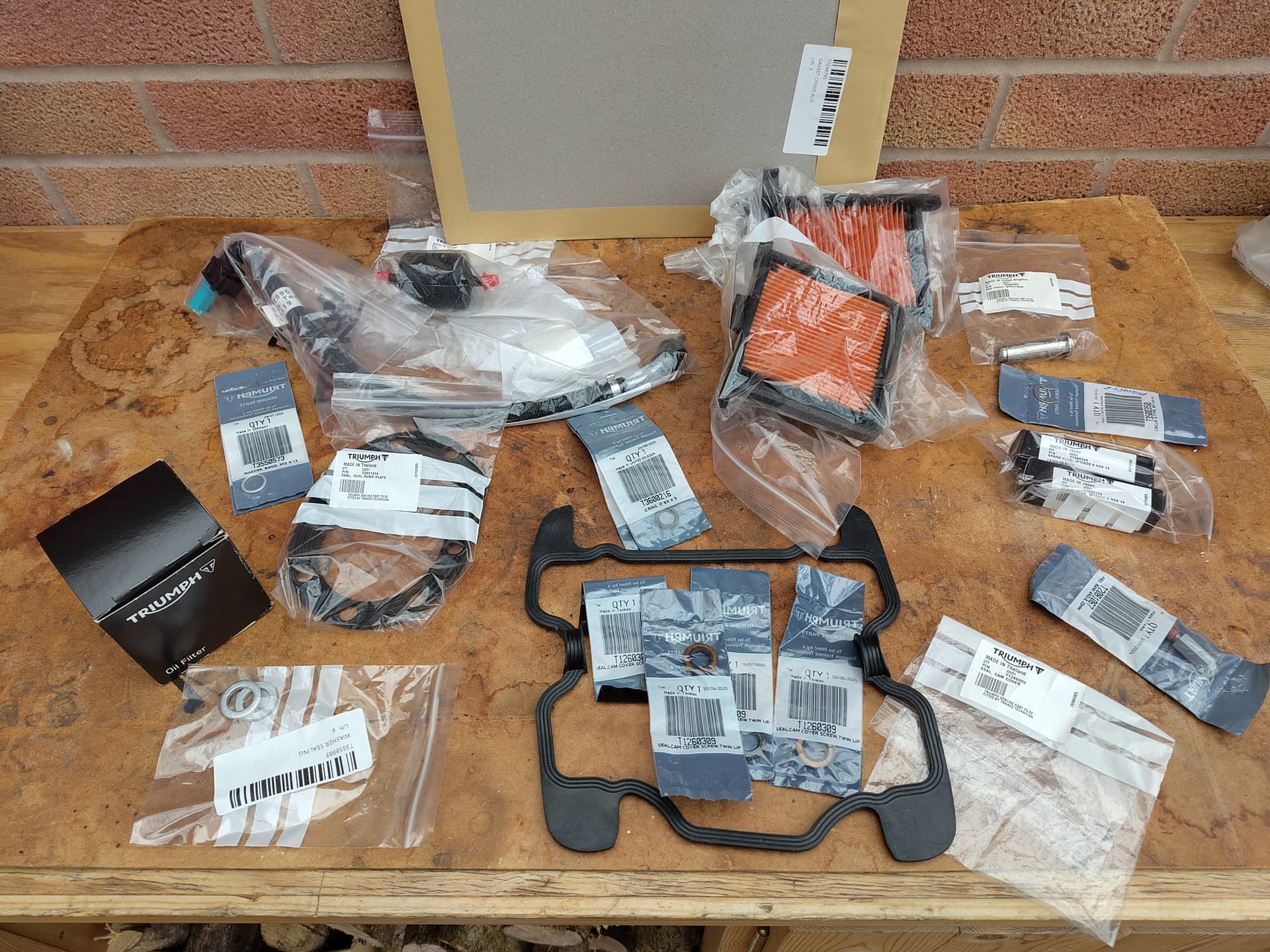
As bike is coming up to 80k miles and 8 years old it’s time for a big service. Triumph’s service schedule has engine valve and cam-chain check every 20k miles. There’s also a fuel filter change which I’ve not bothered with since the dealer’s 2 year service. However, as the fuel hose connector was problematic at last service I thought I’d replace the hose this time and might as well do that fuel filter too. Think I have all the parts I’ll need…
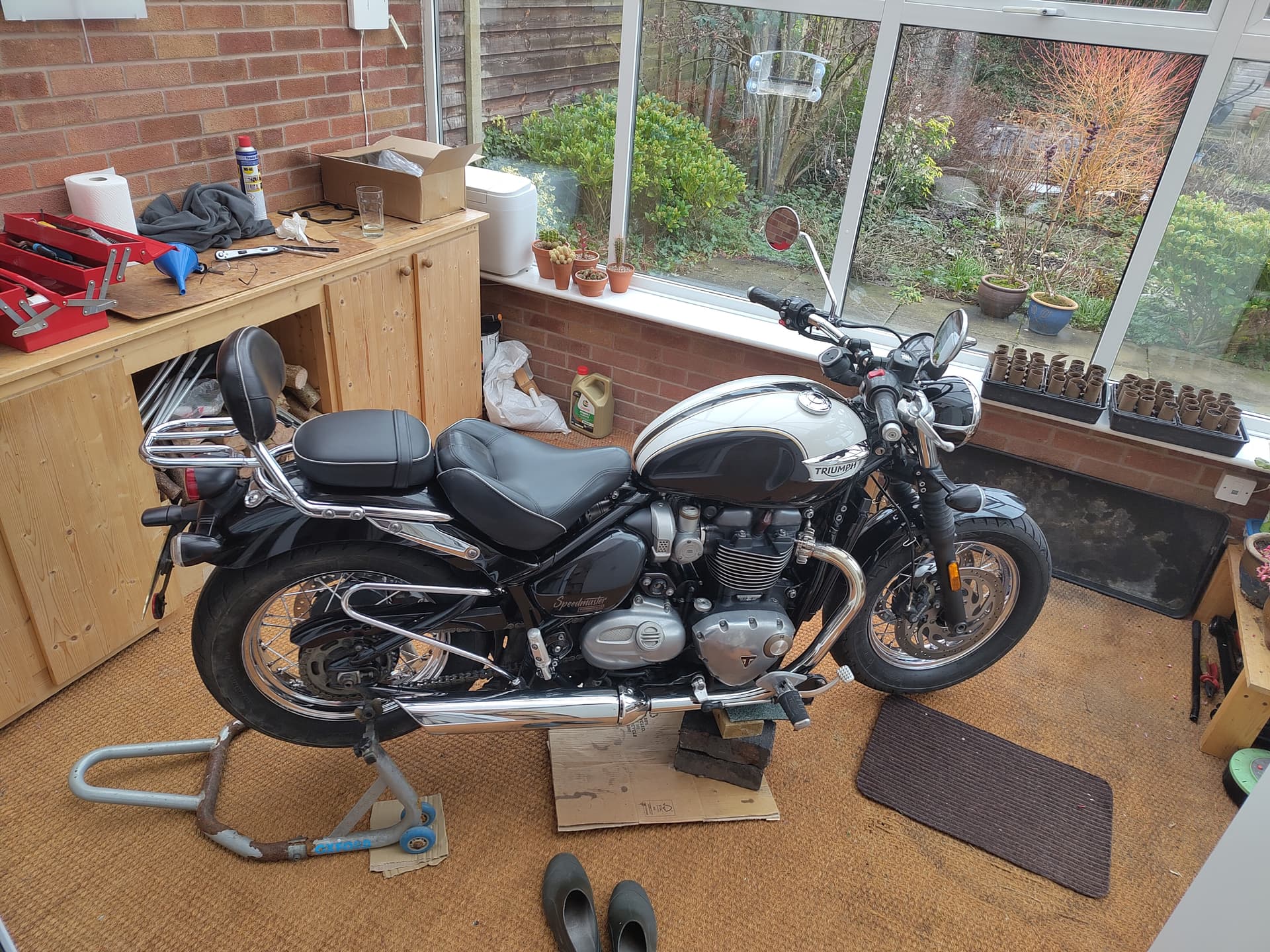
Whilst bike was still outside the first job was to drop oil out the engine. I’ve always though it strange that the standard procedure is to warm the oil by running the engine for a while then wait for oil to drain back down to the sump. Surely, if bike has been sitting idle overnight and the oil fully settled it makes sense to just drain the oil cold. I’ve seen other people suggest that’s OK so I decided to do it that way this time.

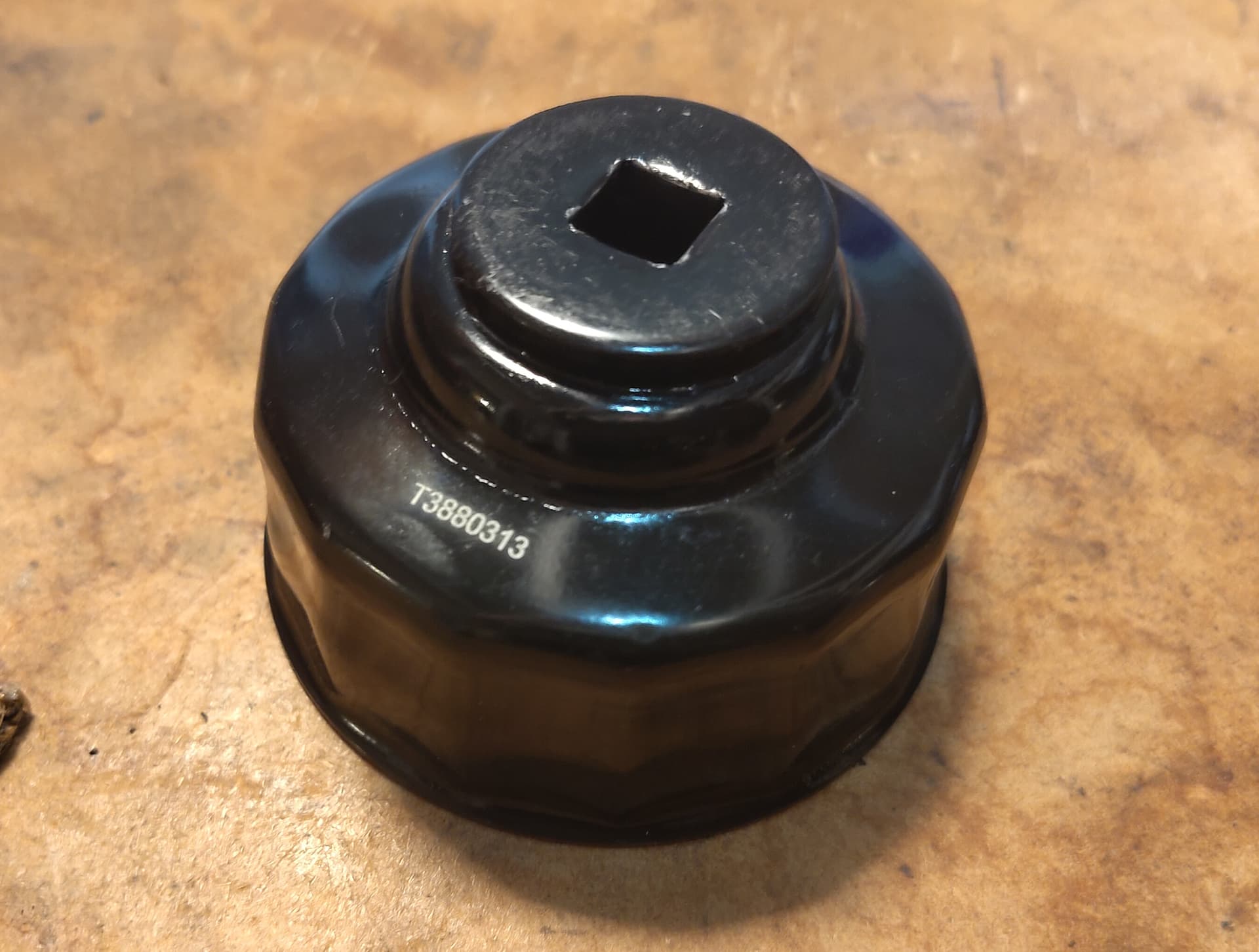
Once the oil was drained, I put back the sump plug with a new washer, and after filling a new oil filter with oil put than in too, using the nice oil filter socket from Triumph.
I didn’t put fresh oil into the engine because to check the cam-chain you need to take the alternator cover off. Last time I did this I also didn’t put back the oil filter and drain plug which I soon regretted after leaving a trail of oil dribbles in the ‘workshop’, which is where it went now.
Removing the petrol tank bolts and propping up the back end gets access to the fuel hose and the white electrical connectors for the pump and fuel gauge.
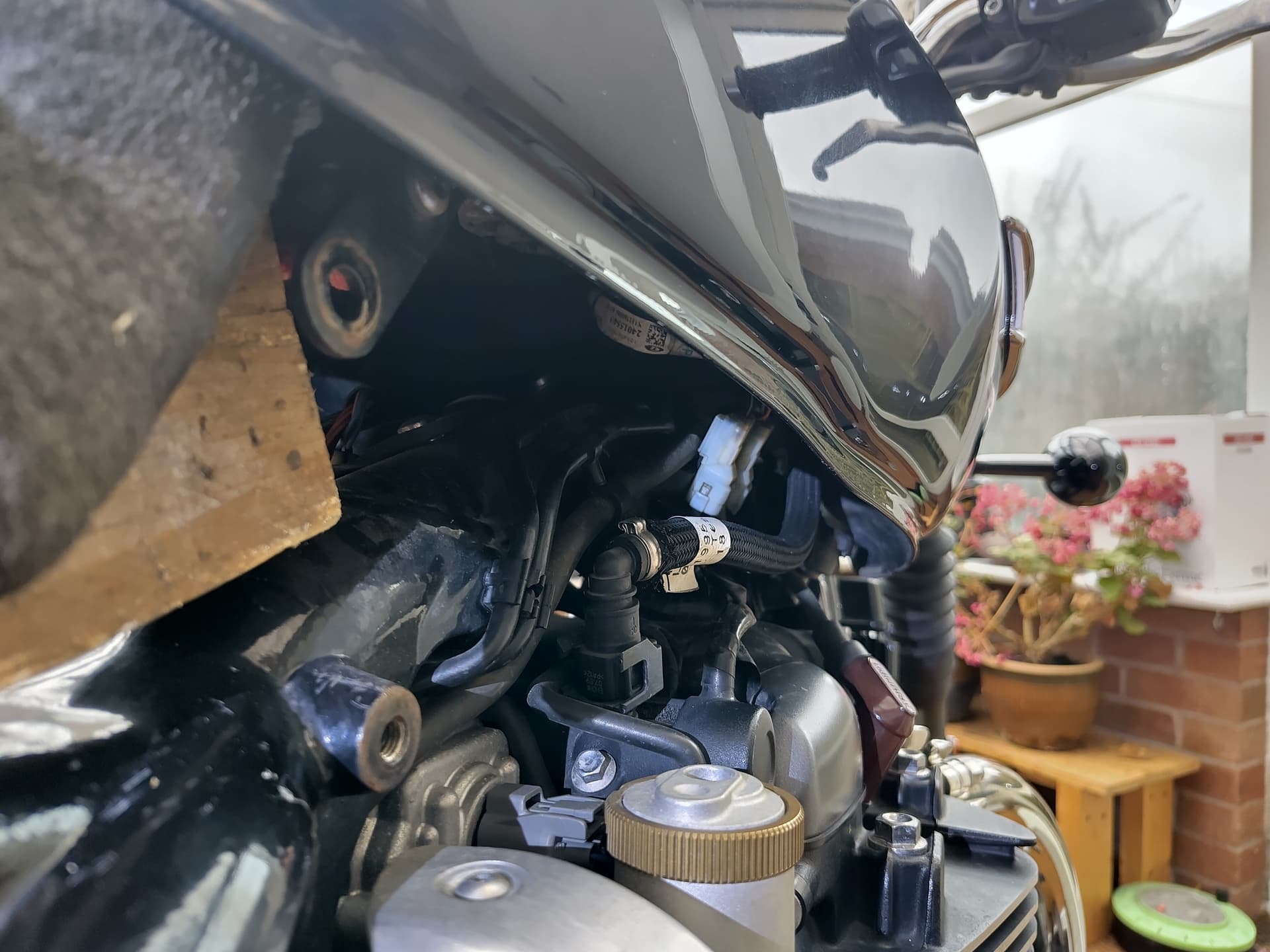
The connectors are pushed onto mounting tabs and lifting them up and off gets lots more room to set about disconnecting them. They are held together by a small clip that is operated by a tiny plastic lever on the long side, you can just about press that with your thumbnail whilst pulling apart the connector halves.

For the fuel hose, there is a sliding cover at the end which reveals ‘buttons’ on opposite sides of the connector for which it’s handy to have special pliers to press in together.
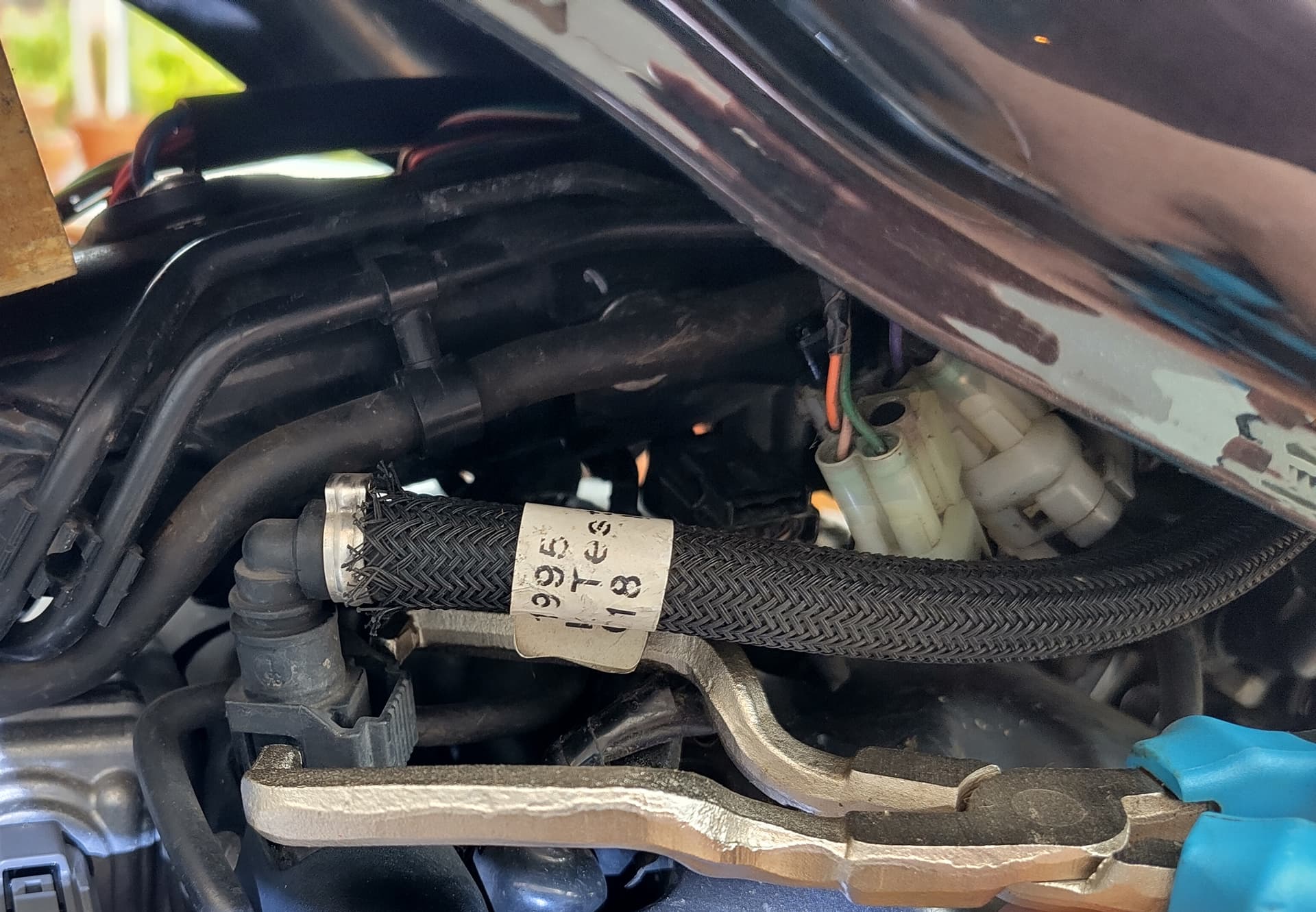
Whilst squeezing the buttons gently to disengage the internal catch, a large force is still needed with your other hand to pull the hose connector straight up. It’s important to pull the connector straight up without wiggling to avoid the danger of braking the plastic tube it connects to.

After pulling off the rubber breather hose on the other side of the tank it can be lifted off. I had used most of the fuel on my last ride, but there was still a litre or so which I now syphoned out the tank before turning it upside down on a cushion.
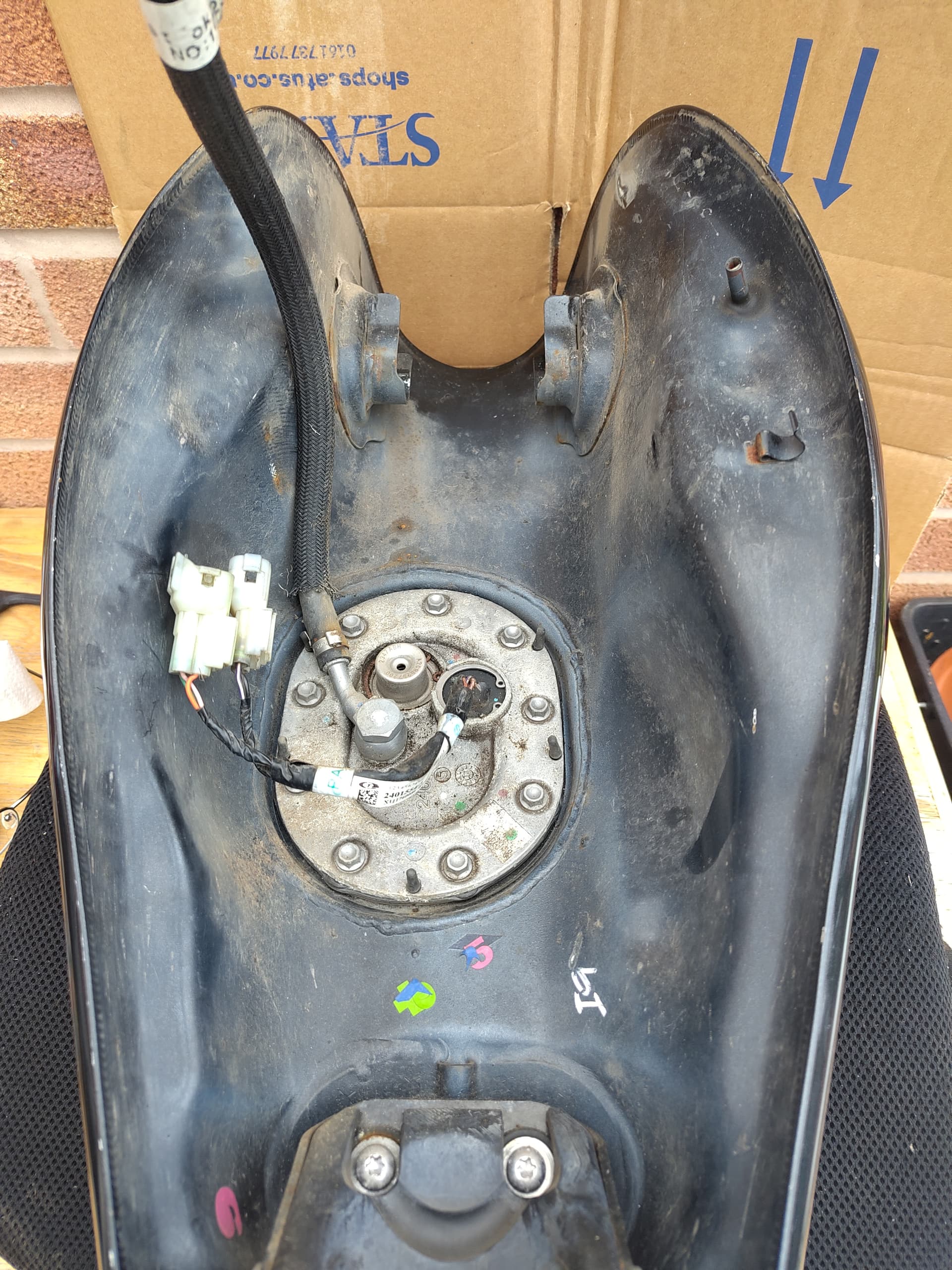
To help avoid getting muck in the tank I blew off any loose dirt then gave it a good clean before removing those 9 bolts fixing the mounting plate for the fuel pump. After much wiggling and cursing all the gubbins started emerging.
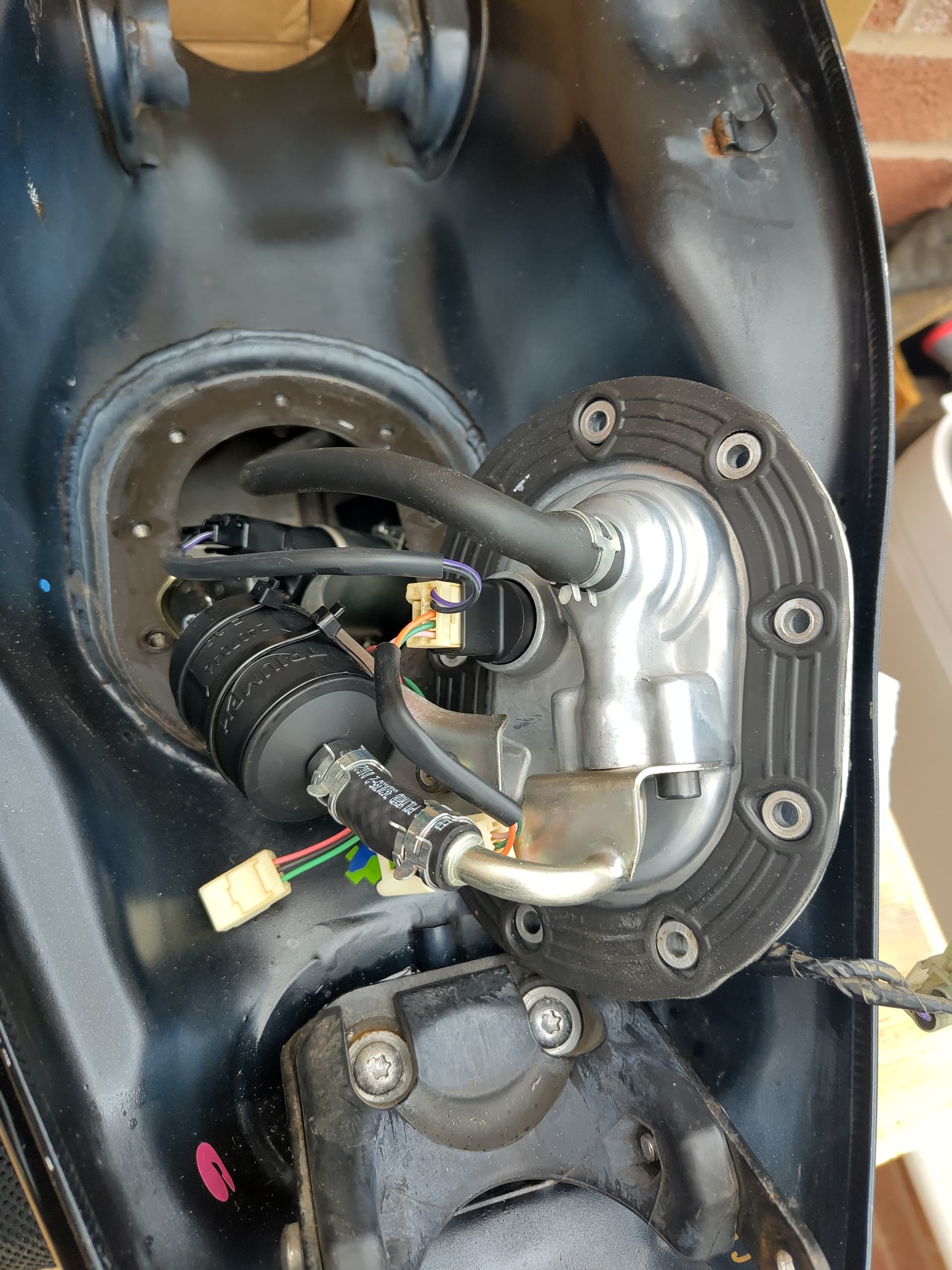
There was a connector for the fuel level sensor than needed unclipping before I could get things completely out.
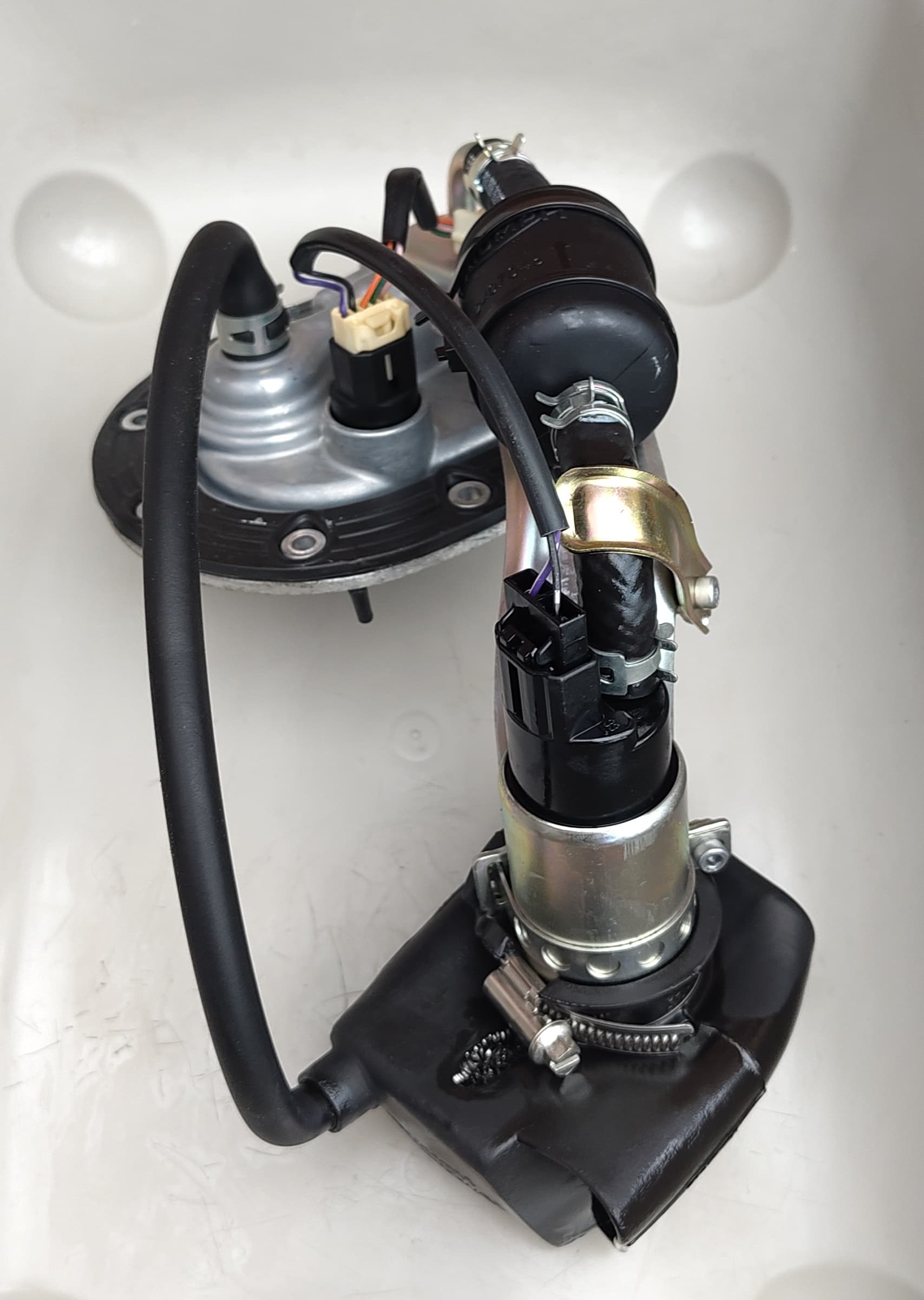
Fuel filter is held in with a couple of cable-ties with spring clips holding on the rubber hoses.
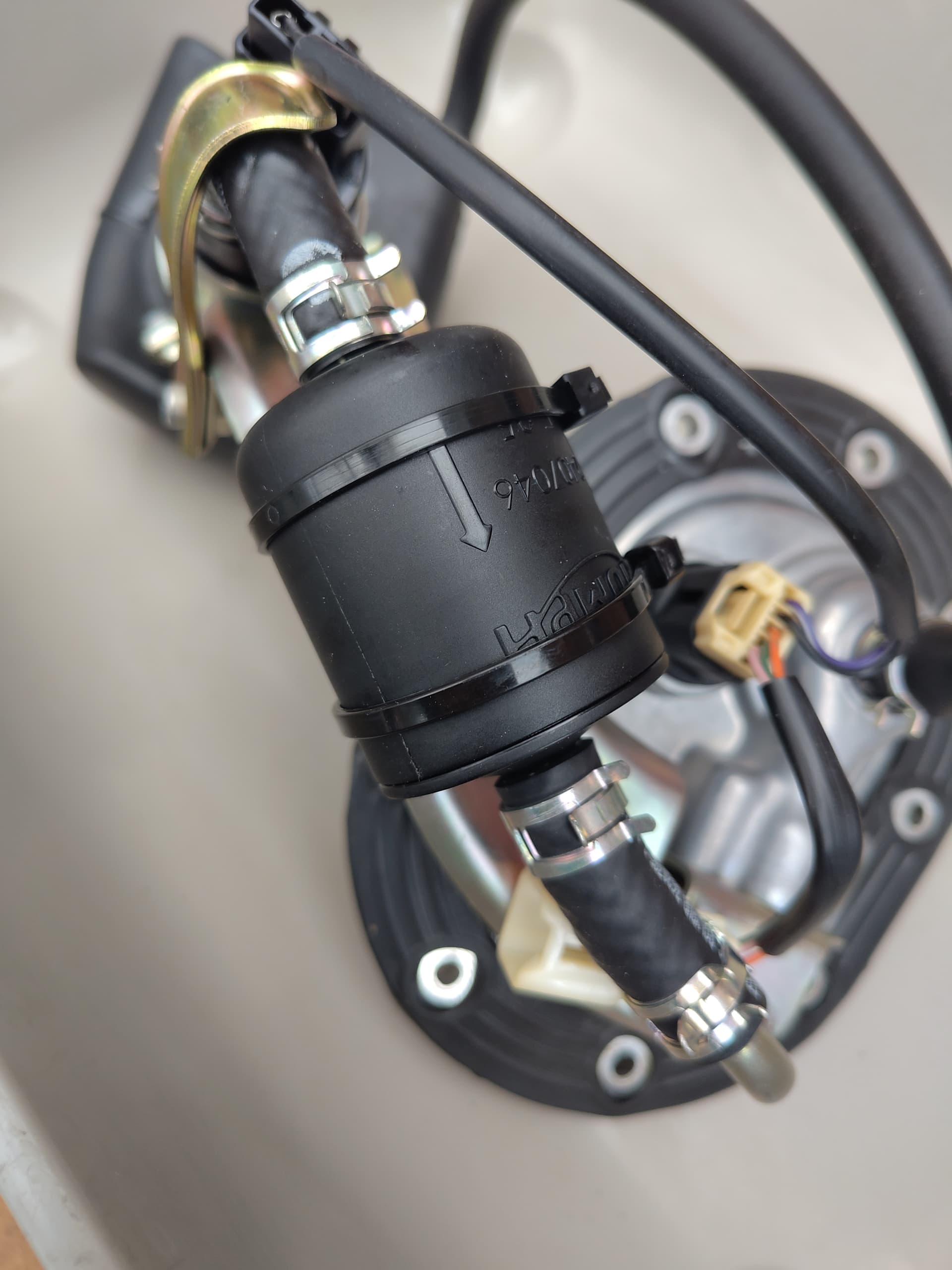
To get the fuel filter out I needed to remove the bronze coloured shield thing and then pull the hose off the fuel pump.
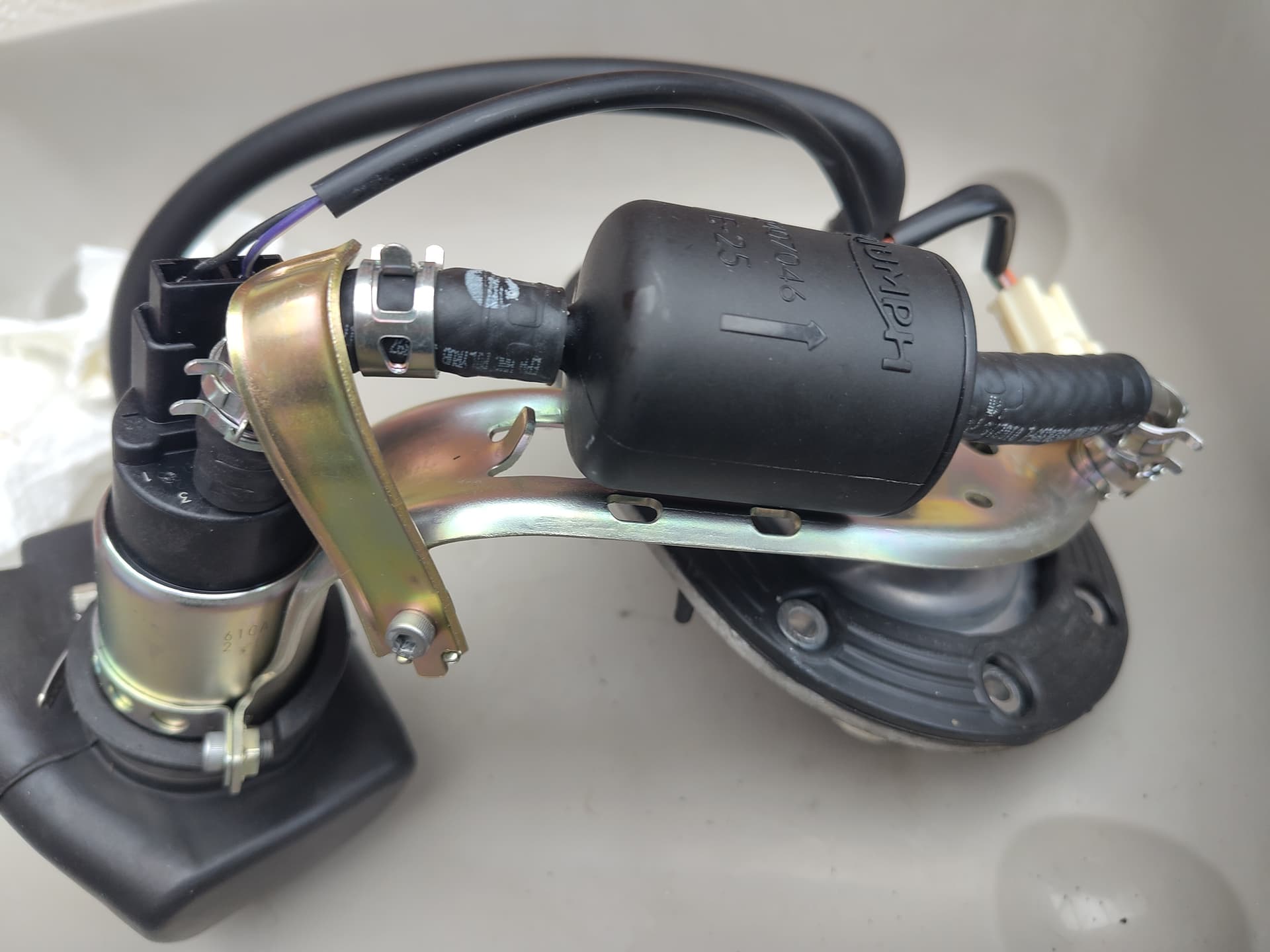
When putting in the new filter, make sure the flow direction arrow on it is the correct way around. And don’t forget the cable-ties like I did and only realised when looking at these photos.

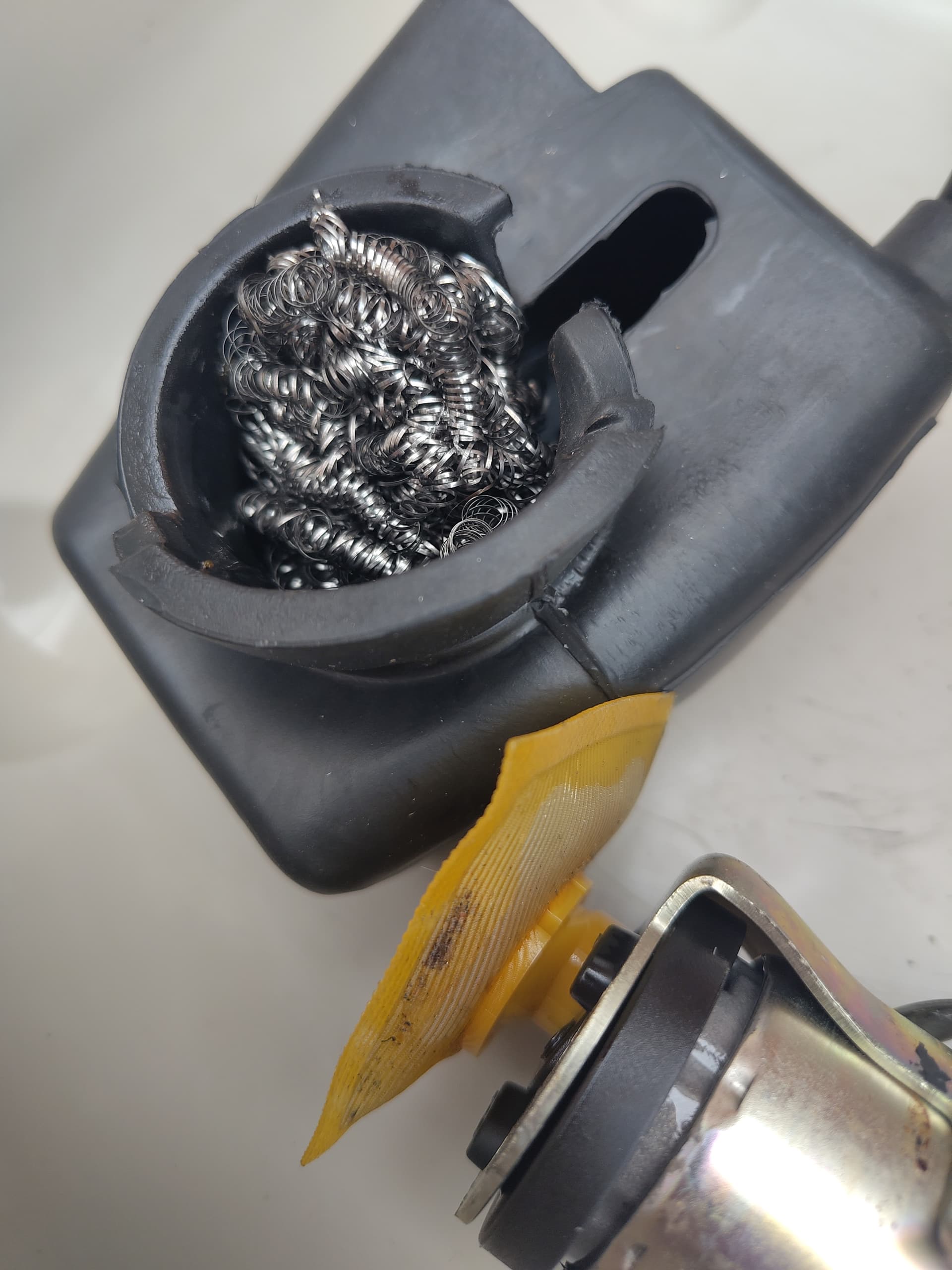
The other end of the fuel pump has rubber hood, inside of which is a filter that looks like a plastic teabag and a pan scourer. There was a little discolouration on the tea-bag but that didn’t brush off when I tried with a old toothbrush.
With the rubber hood back on, I replaced the rubber gasket on the mounting plate with a new one and proceeded with the struggle to re-insert the whole monstrosity back into the tank. This took a large amount of wriggling, with some strategic application of force, and in general a right pig to do. I did remember to re-attach the electrical connector for the fuel gauge, but it was only when looking at the Haynes manual for torque setting I spotted where it said to take note of the routing of the fuel gauge wires. Doh! So I had to get the whole thing out to move the wires, I think this is correct.
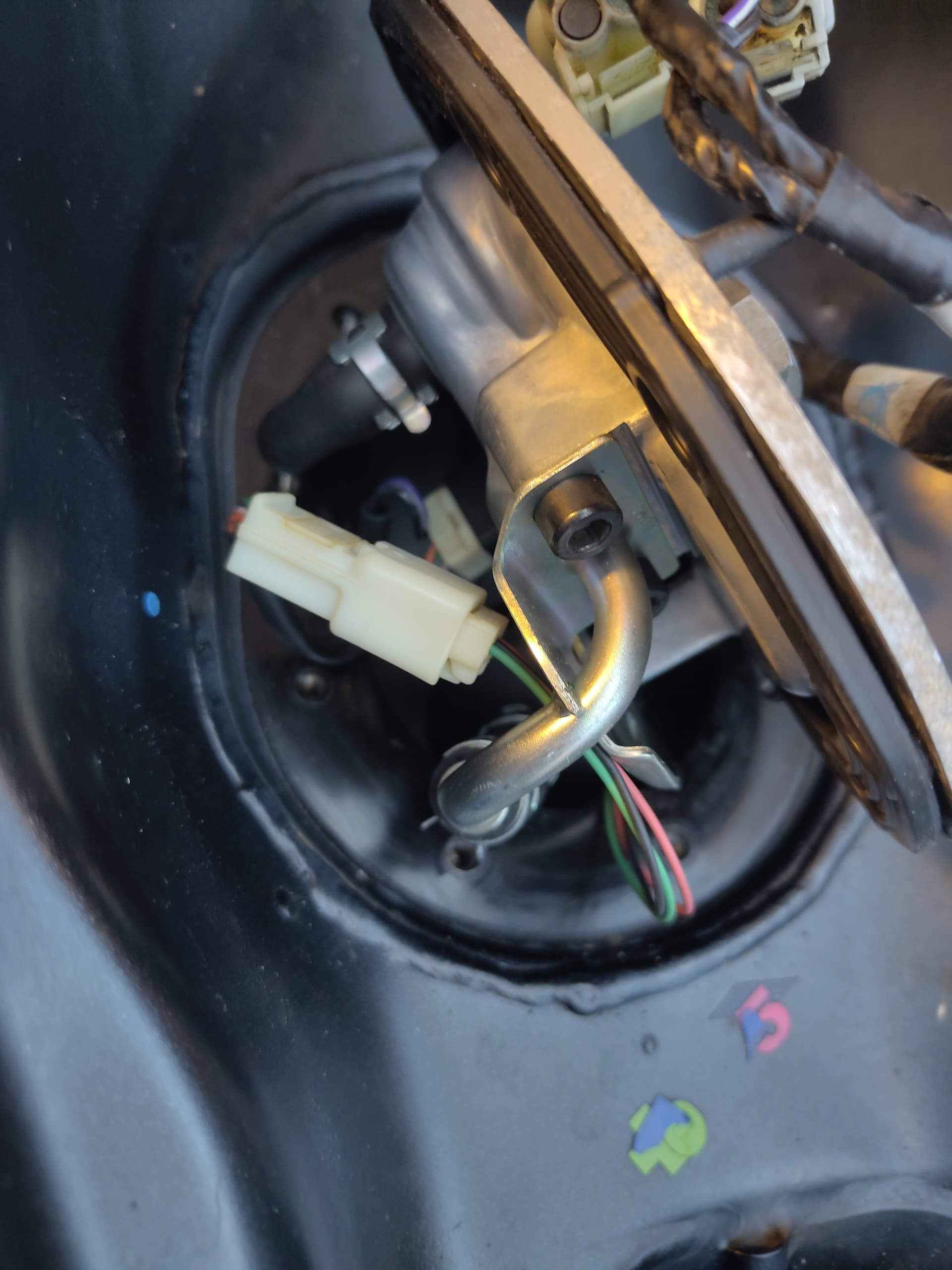
I suspect it’s that white connector that sits on the bottom of the tank making rattling noises when moving the bike around with a low fuel level.

After getting things out for the third time for the the missing cable-ties I replaced the fuel hose with a new one, together with two new washers for the banjo bolt. Haynes manual doesn’t seem to have torque setting for that (or any mention of replacing the hose for that matter) so I’m going to have to get a months subscription to Triumph’s online service manual again. Hopefully that has the torque value.

Edit: Yes Triumphs service manual specified 15Nm for that banjo bold. And the same 5Nm for the mounting plate bolts as the Haynes manual said.
7 Likes

80.000 miles wow.

2 Likes

Yeah I saw that too!!! Brilliant

Well, I lied a little, it’s 75,239 but as I was finding the service was coming due in the summer riding season I did a service early one year to shift things to the middle of winter.

1 Like

Day Two

As the conservatory workshop atmosphere had a distinct whiff of petrol fumes this moring I opened the door and windows to air it out. Then after shutting things up I set up a fan heater to make it warmer than 3°C! With these delays I ended up waiting until after lunch before getting to work.

To check the valve clearances I needed to get the cam cover off. Not much space for that!

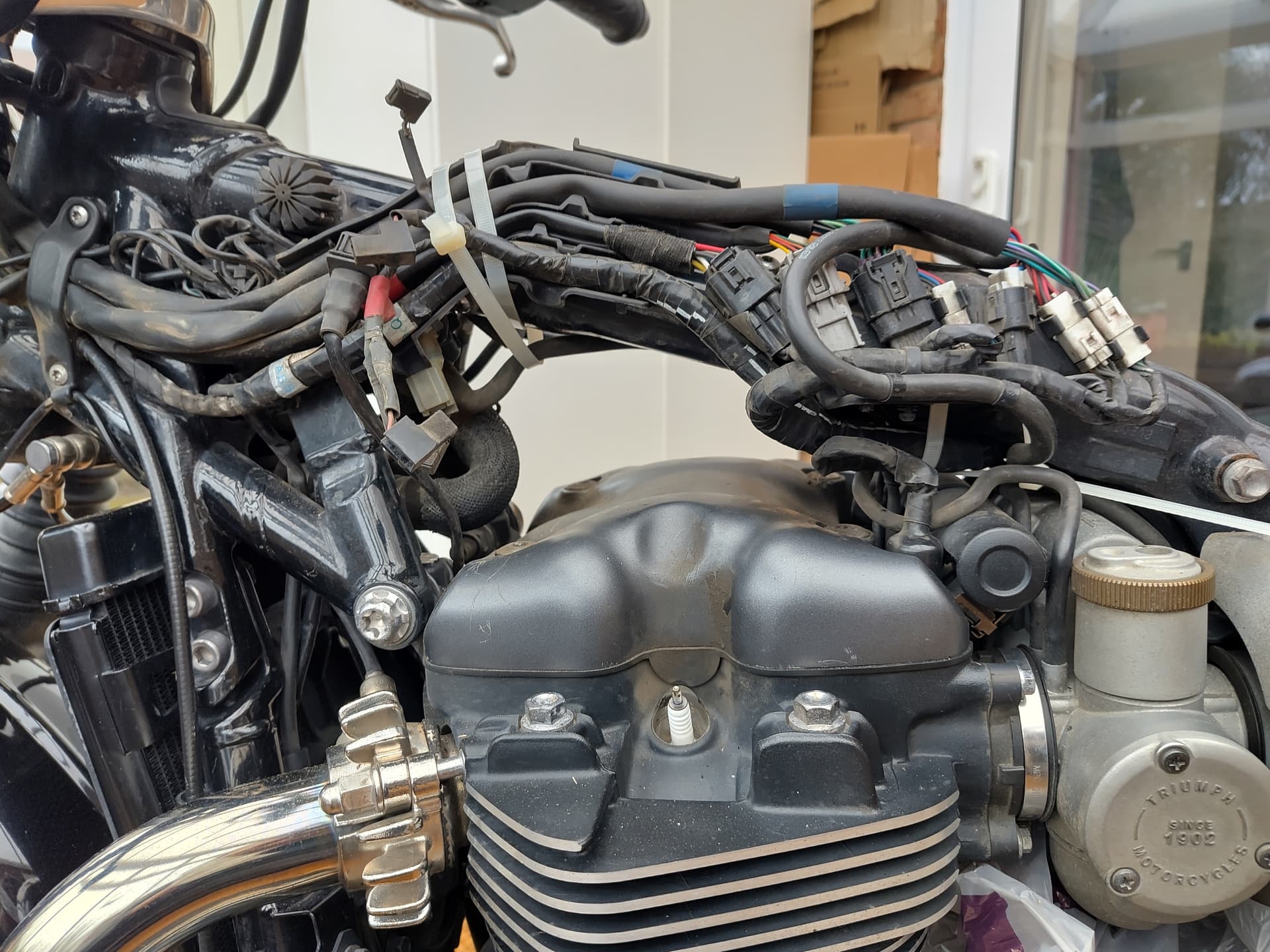
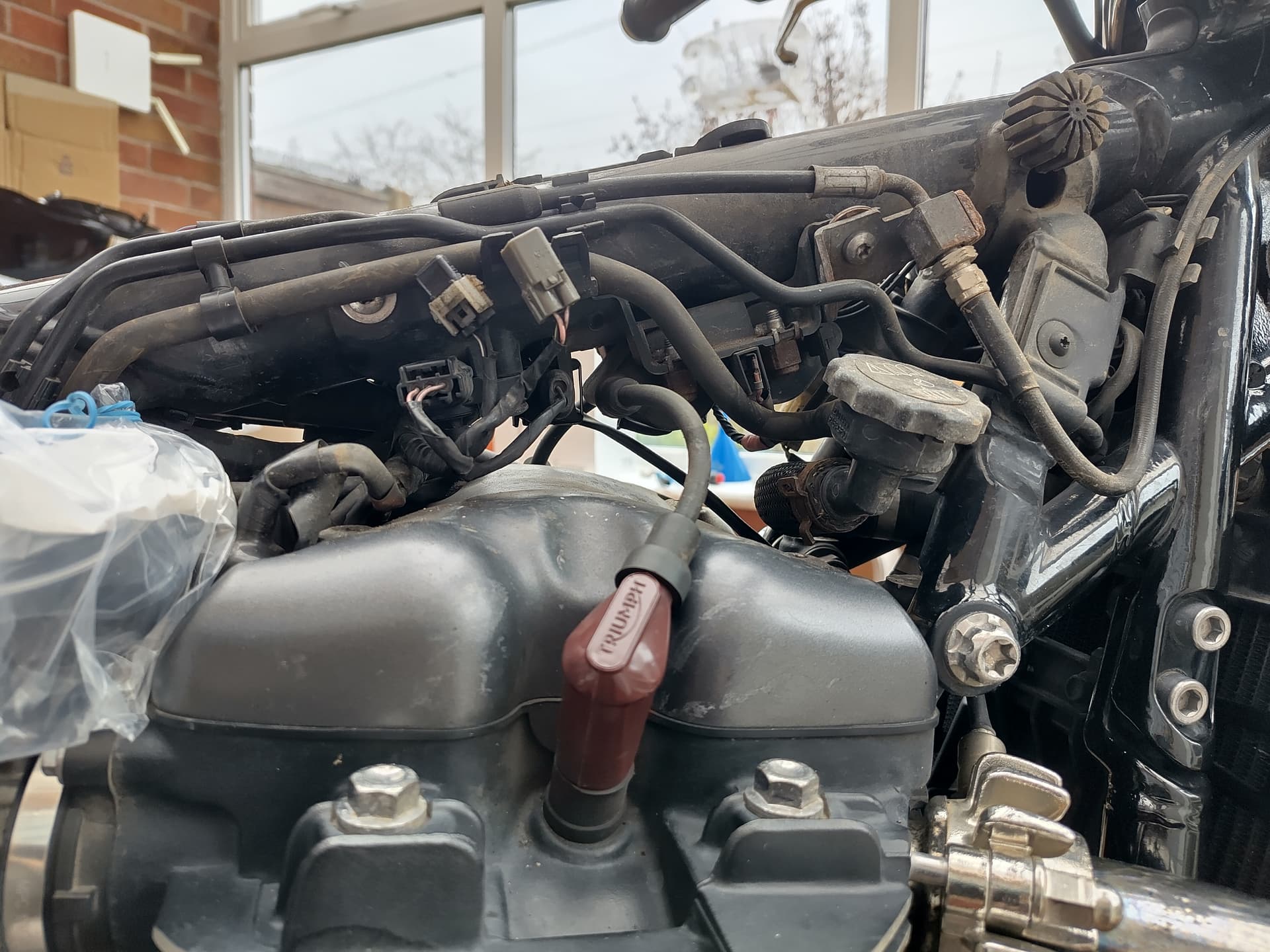
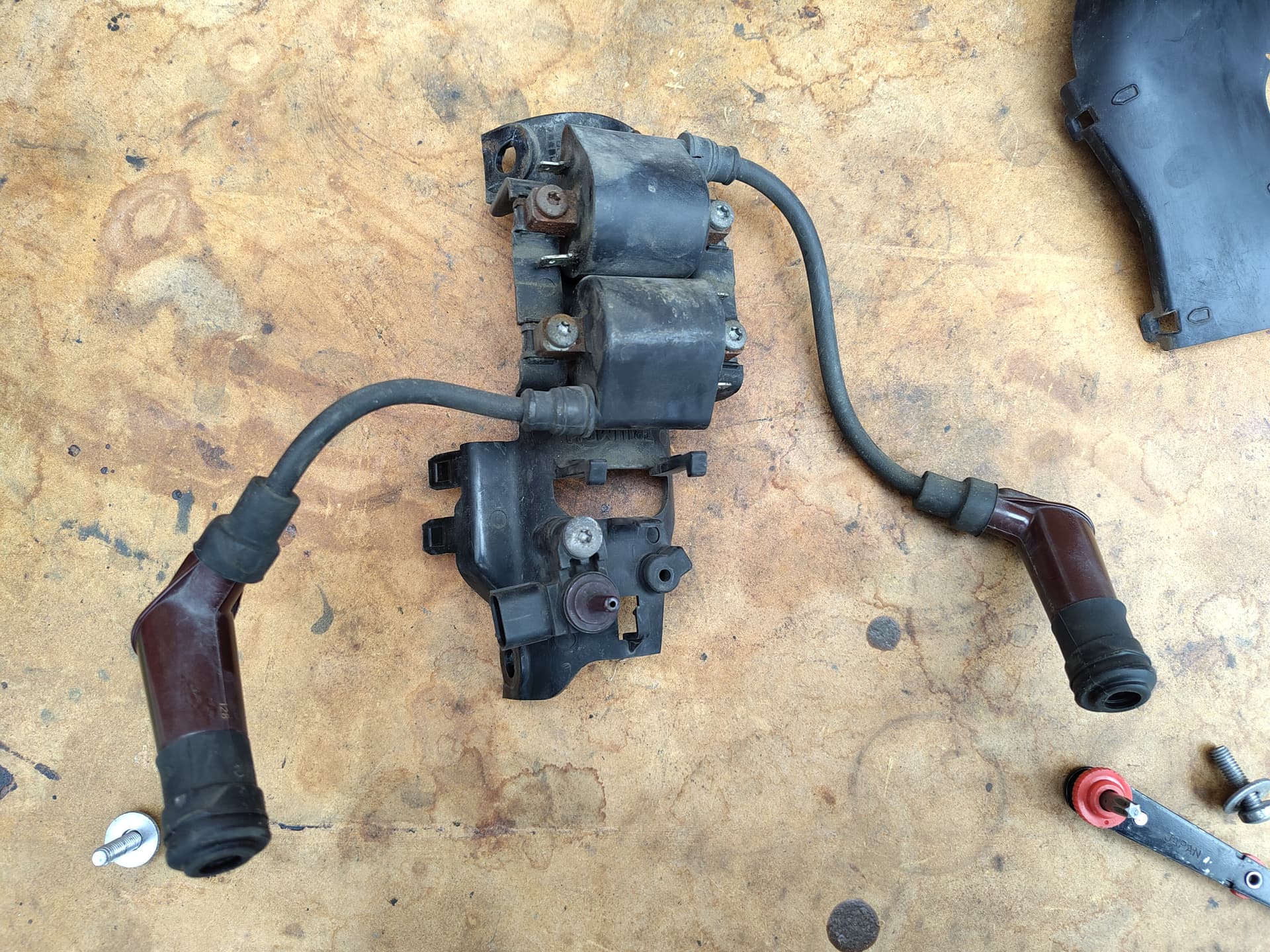
So after undoing a few screws and unplugging some connectors I got the ignition coils off with their plastic mounting.

The plastic cable harness support also needs unscrewing and everything cable-tying out the way.

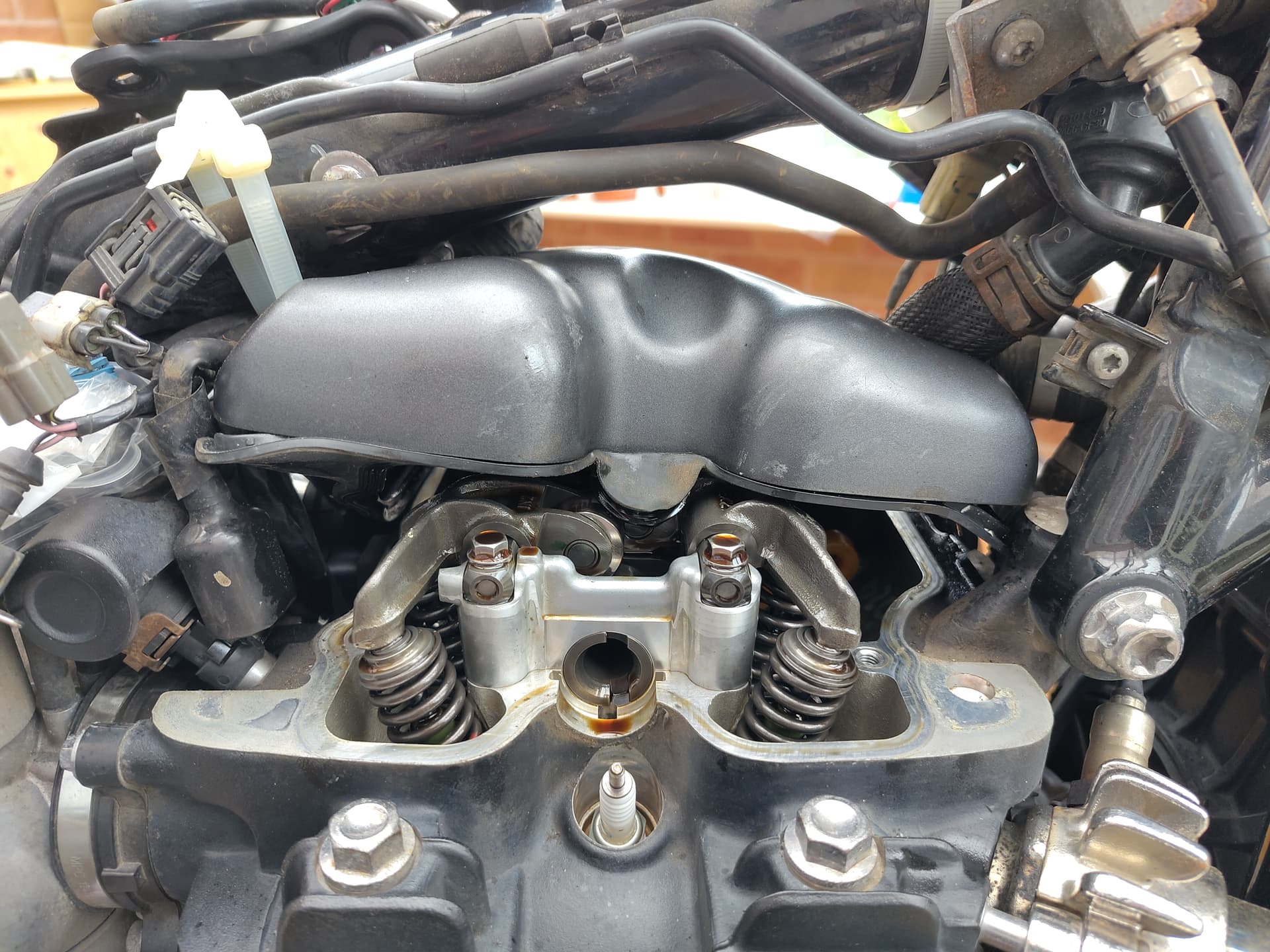
After removing the mounting screw for the coolant filler cap and pushing it out the way I was now ready to remove the cam cover.

There’s still not enough room for an easy exit and the cover needs forcing out past the coolant hose and other bits. That’s not too bad for removal, but is a major pain when trying to put the cover back on and getting it’s rubber gasket aligned properly.

With the bike in top gear and the spark pugs unscrewed nearly all the way (to relieve compression pressure) it’s possible to turn the cams via the back wheel. The clearance needs measuring when a cam lobe is pointing in the opposite direct to the roller on the rocker, but it’s impossible to see them properly. I can’t remember how I did it last time but today I hit on the idea of turning engine until I could see a valve spring reach maximum compression then measure the clearance on the corresponding valve on the other cylinder. It was only after doing this that I realised that engine has a 270° crank so TDB on one cylinder isn’t BDC on the other. :frowning: So I did it again, this time when reaching maximum compression I made note of the orientation of the slot in the end of the camshaft then turned the engine over until the slot had rotated half a turn. I still got similar measurements this way,
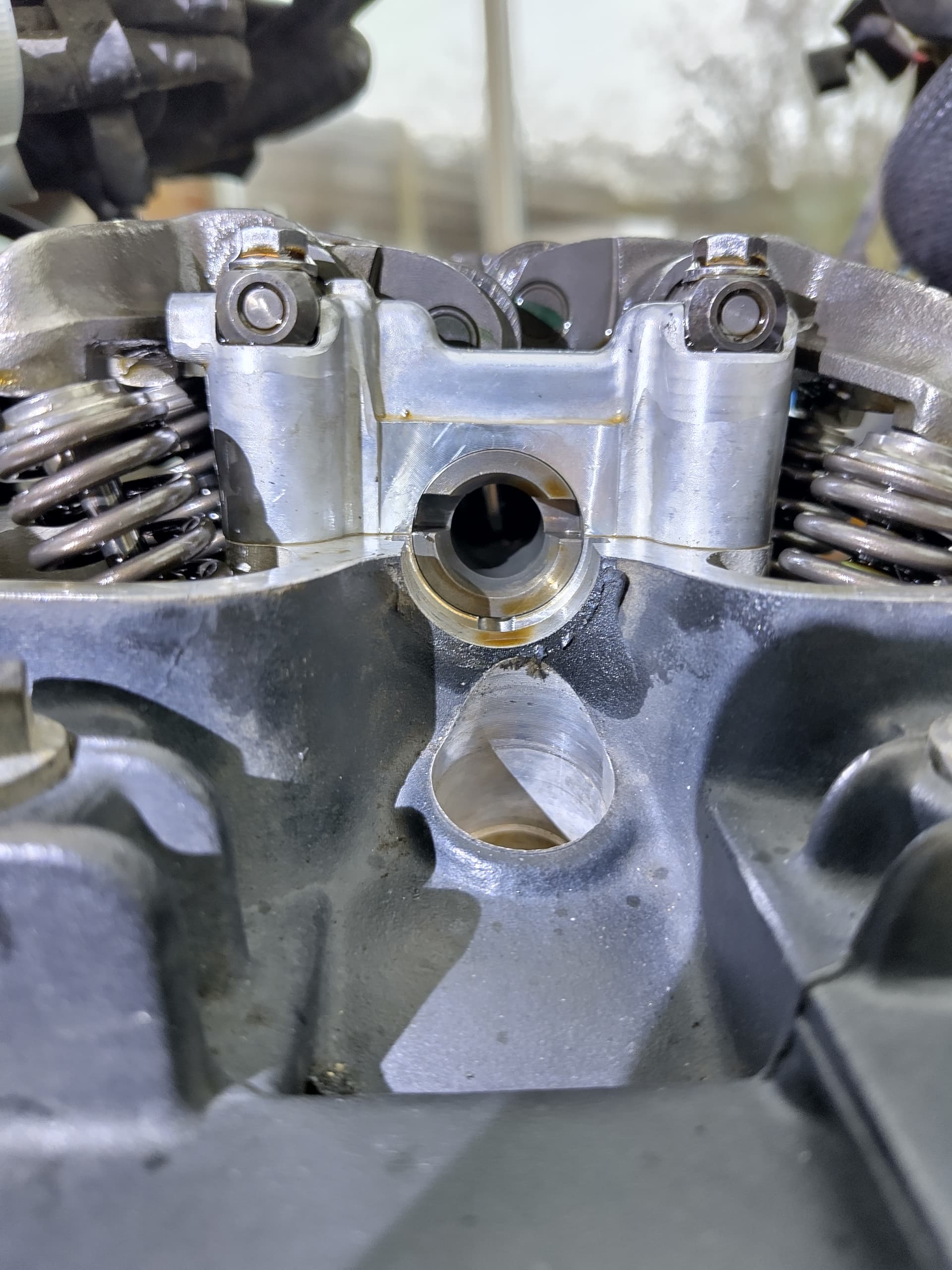
All the valve clearance were in tolerance but the outside inlet valves are at the top end of their range so am somewhat conflicted as what to do. The only time I’ve changed valve shims was 4 years ago when all the inlet valve were at or below the minimum. I could dig out two of the original shims and put them back to close up the gap again. The reason this is difficult to decide is that every time you rotate the engine and try and measure clearance you get a slightly different reading.

Anyway, the other thing I planned on checking today was the cam timing. There isn’t a procedure for this specified by Haynes and the Triumph service manual only gives the full timing setting procedure, complete with special chain tensioning tools. So I borrowed from the latter to do the same procedure as in previous years.

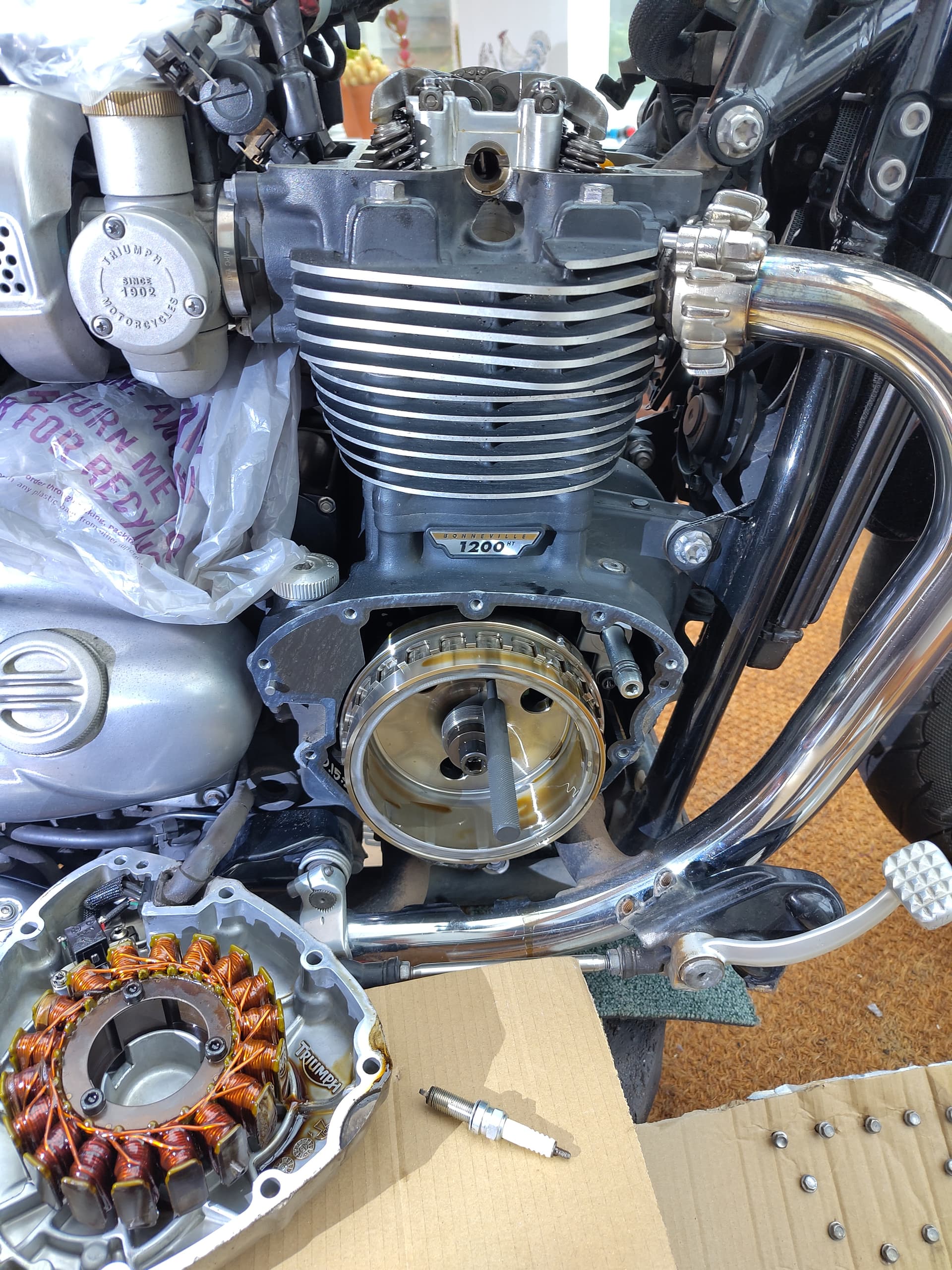
The alternator cover needs removing, for which there is a specified sequence of bolt removal (and a different one to put them back again). Inside the alternator rotor is a small hole which needs aligning with a corresponding hole behind in the crank case, and I think another moving part beyond. I have the official Triumph service tool which you push through these holes to check alignment. Though a screw driver or metal rod of suitable diameter should do.

The idea is that when all these holes are in alignment the slot in the end of the crank shaft is in line with the top surface of the cylinder head.

To get all this aligned I turn the engine (via the back wheel) in the direction that the cam chain is pulling down the rear side of the sprocket, as it would if the engine was running. Today everything was still aligned, so seems after 75,000 miles cam-chain isn’t worn much. :slight_smile:

Now comes the real tedious and irritation bit, carefully and meticulously scraping off the old alternator gasket with a razor blade. :frowning: When I last did this I said I wouldn’t bother again with the timing check, which I’ve told myself this time too, maybe my future self will listen this time. :slight_smile:

As the light was fading and my back aching I stopped gasket scraping after about half an hour, about a third of the way done.

4 Likes

75000 still very impressive have you owned the bike from new

1 Like

Yes, bought it new in June 2018.

With the bike that old and with that amount of mileage I would urge you to double check the Triumph service recommendations.

My reason for advising thus is I booked my Striple in for it’s fourth year service and when I asked what it included I was given a copy of the service schedule. To my surprise it included the replacement of all fuel and coolant hoses irrespective of mileage.

When I put the machine into the dealer I asked to be given all of the hoses that they were due to replace for me to put on the shelf for just in case. On collecting the machine I was told that Triumph had revised the schedule and hose replacement was no longer needed and was given a copy of the service schedule which they had worked to with all the items ticked, including hose replacement.

I contacted the after sales team at Hinkley who had a word in the dealer’s ear and was asked to take the bike back for the service to be completed. The dealer then tried to charge me extra for the replacement hoses (£100) but another email to Hinkley sorted that as well.

So, as your machine is twice the age of my Striple I wouldn’t be surprised if there were any time related actions to be attended to.

Looking at the last but one photo I was surprised to see the alternator in what I would have called the timing chest. So what’s in the primary chain case?

Yes, the service schedule has to replace fuel hose every 4 years, which seemed excessive. This time was the first time I replaced it. It also says to replace the evap hoses which I haven’t done.

The full service schedule items are in the owners handbook which is the same as in Triumph’s service manual.

Well, there’s no primary chain, the other side is the clutch driven by gears. For a photo see me replacing a broken clutch lifter bearing…

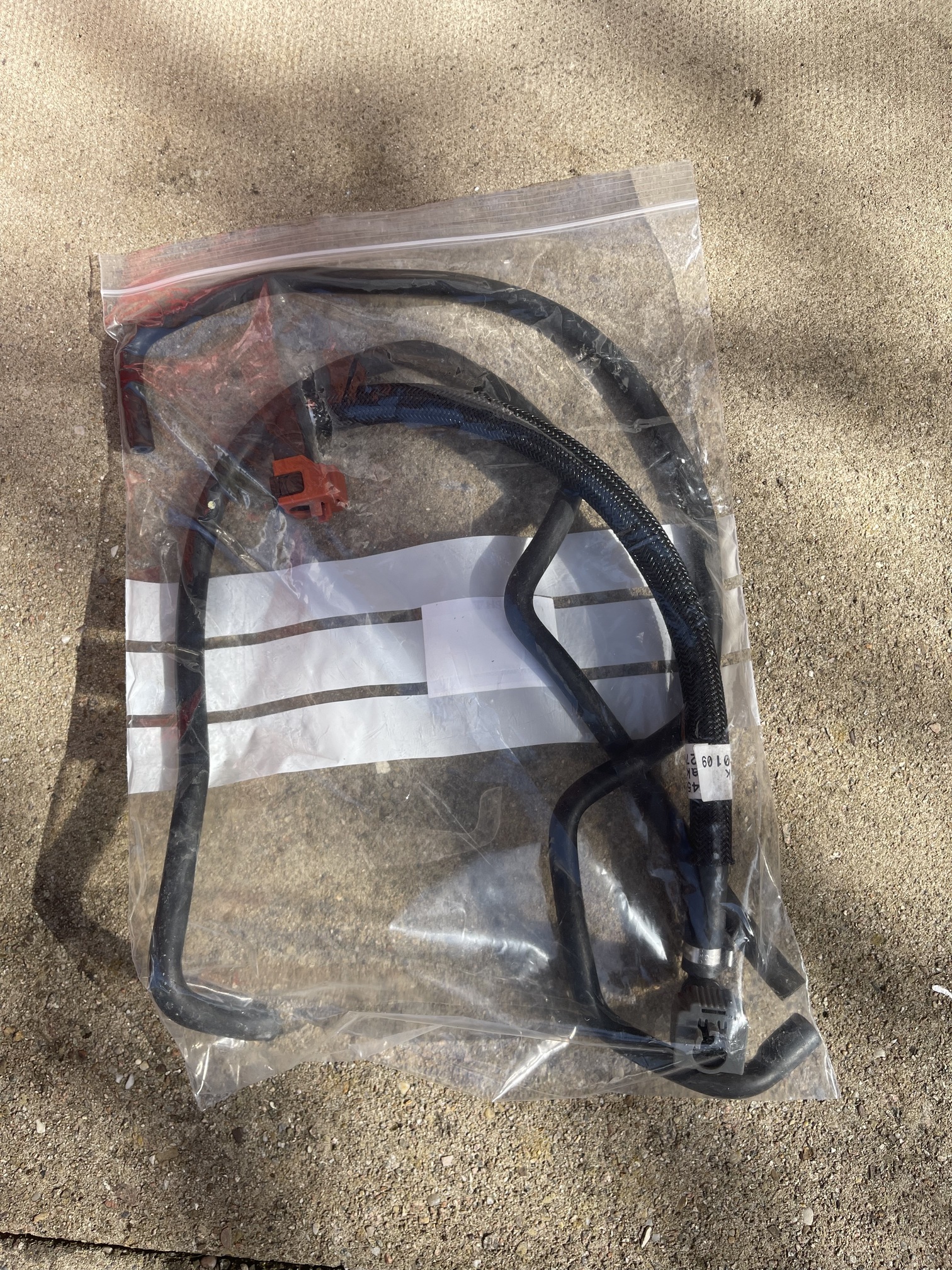
I think my service schedule referred to them as evap hoses. This photo shows what were replaced.


Of course. That’s where the starter motor fits in. Most interesting.

I never worried about the evap hoses because they’re just for environmental emissions control where the petrol tank breather goes into a carbon canister, which then via an electrically operated valve feeds air from said canister (with absorbed petrol fumes) back into the air intake on the throttle bodies. Only way that could affect engine running is an air leak on the hose letting in unfiltered air. So if anything, probably makes sense to just bung up the holes on the throttle bodies.

1 Like

Yes, starter motor is outside on top of the engine casing with it’s spindle poking through the crankcase to engage with one of those cogs to turn engine over.

1 Like

Day Three

Didn’t have much time to work on bike today but I did finish scraping off the old gasket then refitted the alternator cover with a new gasket, and new o-rings for the balancer shaft adjuster.

I’ve decided to change the valve shims I measured yesterday as borderline, but that’s a critical job I don’t want to start without lots of available time to take things steadily. So instead for today I decided to do some of the simple jobs that don’t require much brain power, like fitting new bank angle indicators to the footpegs.

That’s the left one, right one, and new one. I obviously lean more in right turns or perhaps it’s the road camber that causes the un-even wear. Whatever the reason, at least yearly I end up moving the longer left one to the right peg and fit a new one to the left. Nice simple two minute job, except, the thread in the right footpeg is buggered from a few years ago when I had to remove an indicator worn past the hexagonal bit. This time the thread finally gave up. I’ve resorted to epoxying the thing in but I don’t expect it to last past the first few scrapes. I’m probably going to have to buy a new peg for £86

By now I decided I didn’t want to do any more of the ‘simple’ bike jobs so cut a piece of cake and opened a bottle of beer…

5 Likes

Day Four

The first goal for today was to deal with the two inlet valve clearances that were at the top of the acceptable range (0.13mm). From previous services I already had two replacement shims that would take off 0.05mm and get the perfect middle of the range reading of 0.08mm.

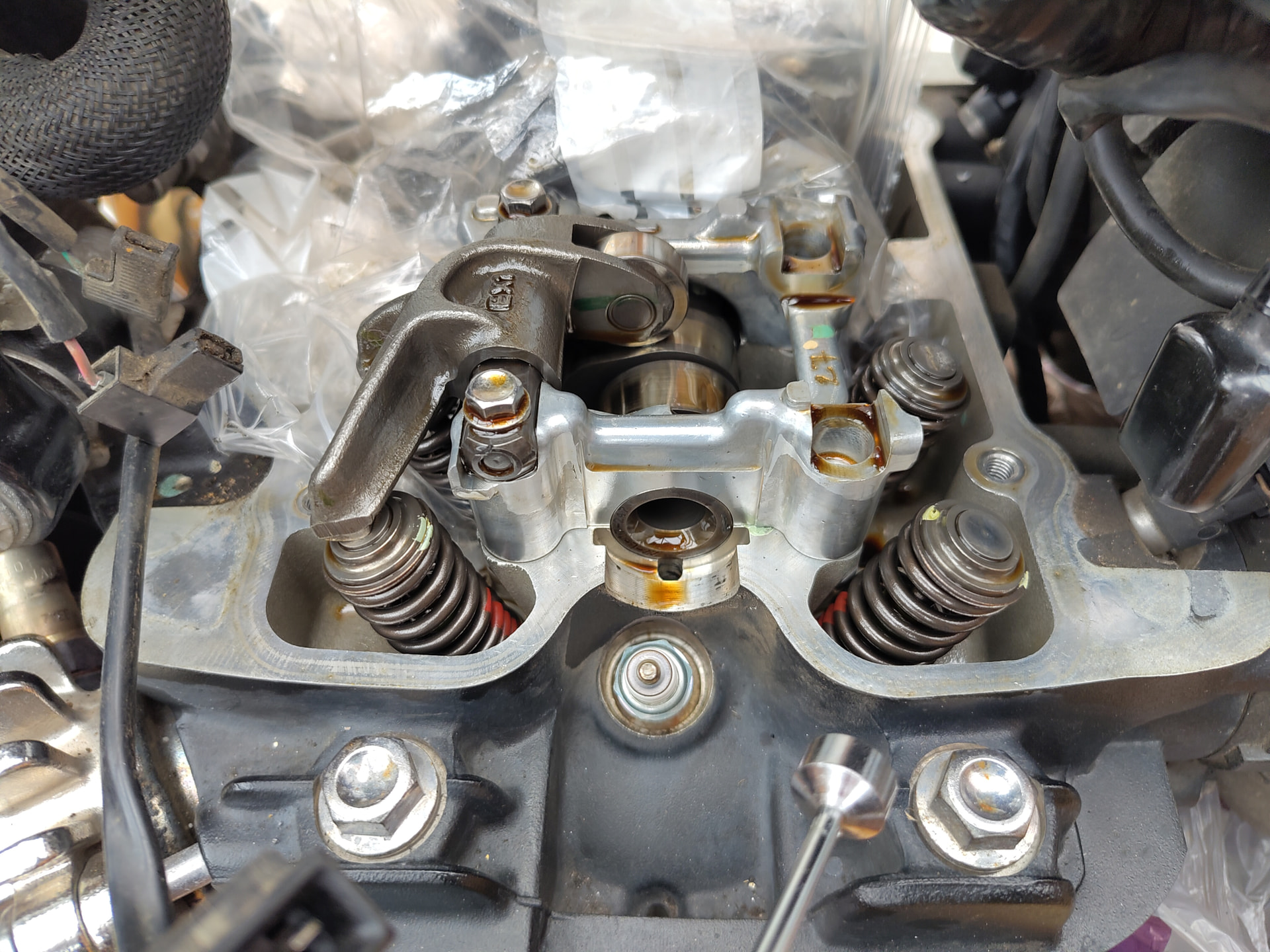
So after checking the first clearance read same as yesterday I removed the rocker arm and used a magnet-on-a-stick to remove the old shim. Note the plastic bags stuffed into the gaps around the cam chain to stop anything dropping into the engine. :scream:

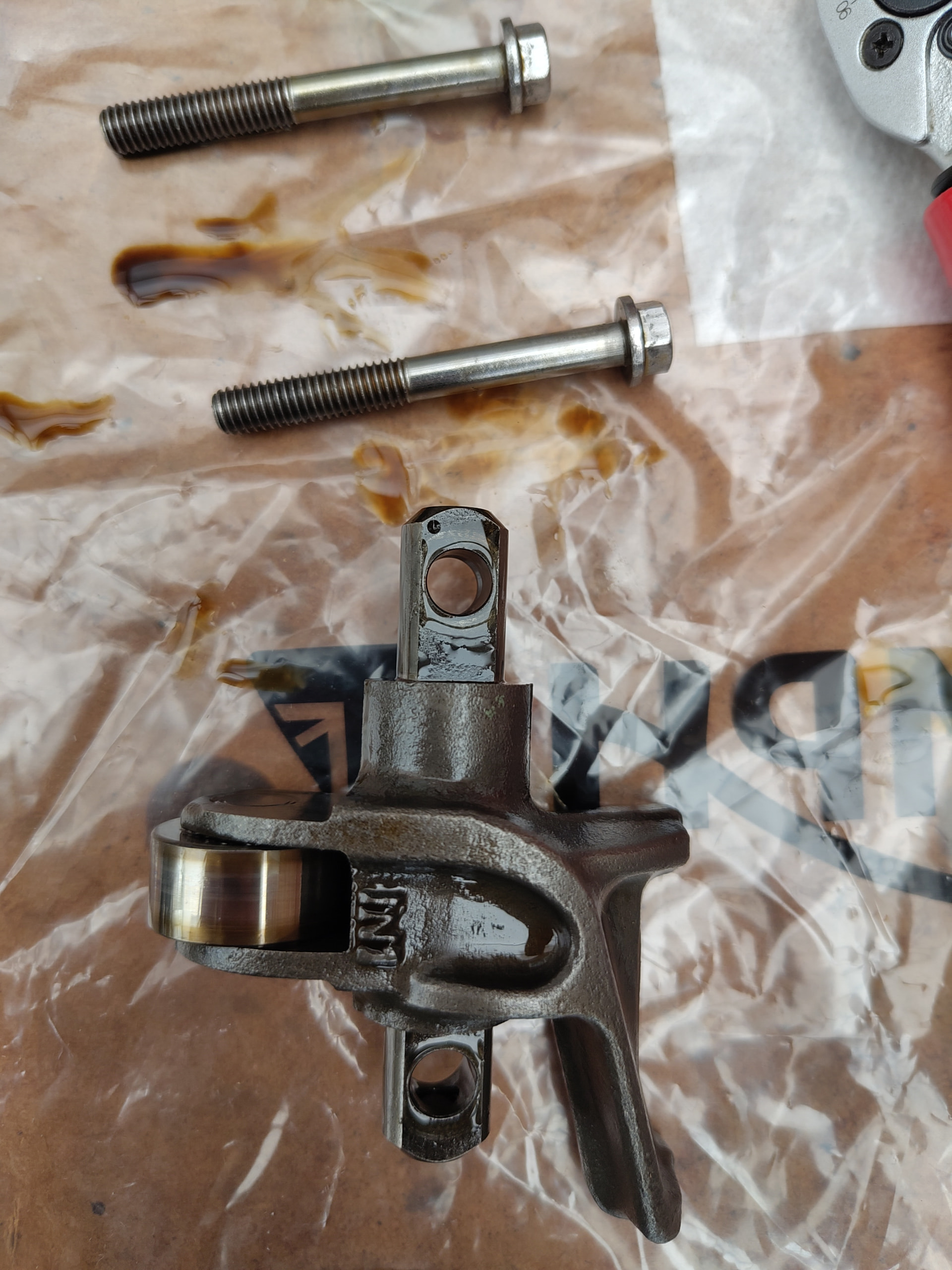
After putting the replacement shim in place, with size marking down, I put the rocker arm back on. It is vital that the rocker shaft is the correct way around so that oil channels align. One end has a dot near the bolt hole and that faces up and is the end nearest the cam shaft sprocket.

I measured the new clearances for the 2 valves and found that the one I hadn’t touched had gone down by 0.05mm and the one I changed had reduced a similar amount extra than it should have. I remember having this problem last time. I gave the engine several turns to make sure the shims were seated but that made no difference.

The thing is, the one I had changed was now below the minimum allowable clearance and I didn’t have the intermediate size to fix this. After debating whether to order more shims I decided to put the old one back in, which now duly read 0.05mm less than before all this faff, making it nicely in tolerance. This situation felt completely unsatisfactory, but as the original measurements yesterday were actually just in tolerance I decided I would just leave things as they were. I decided to not touch the other inlet rocker either, let’s just get this thing back together…

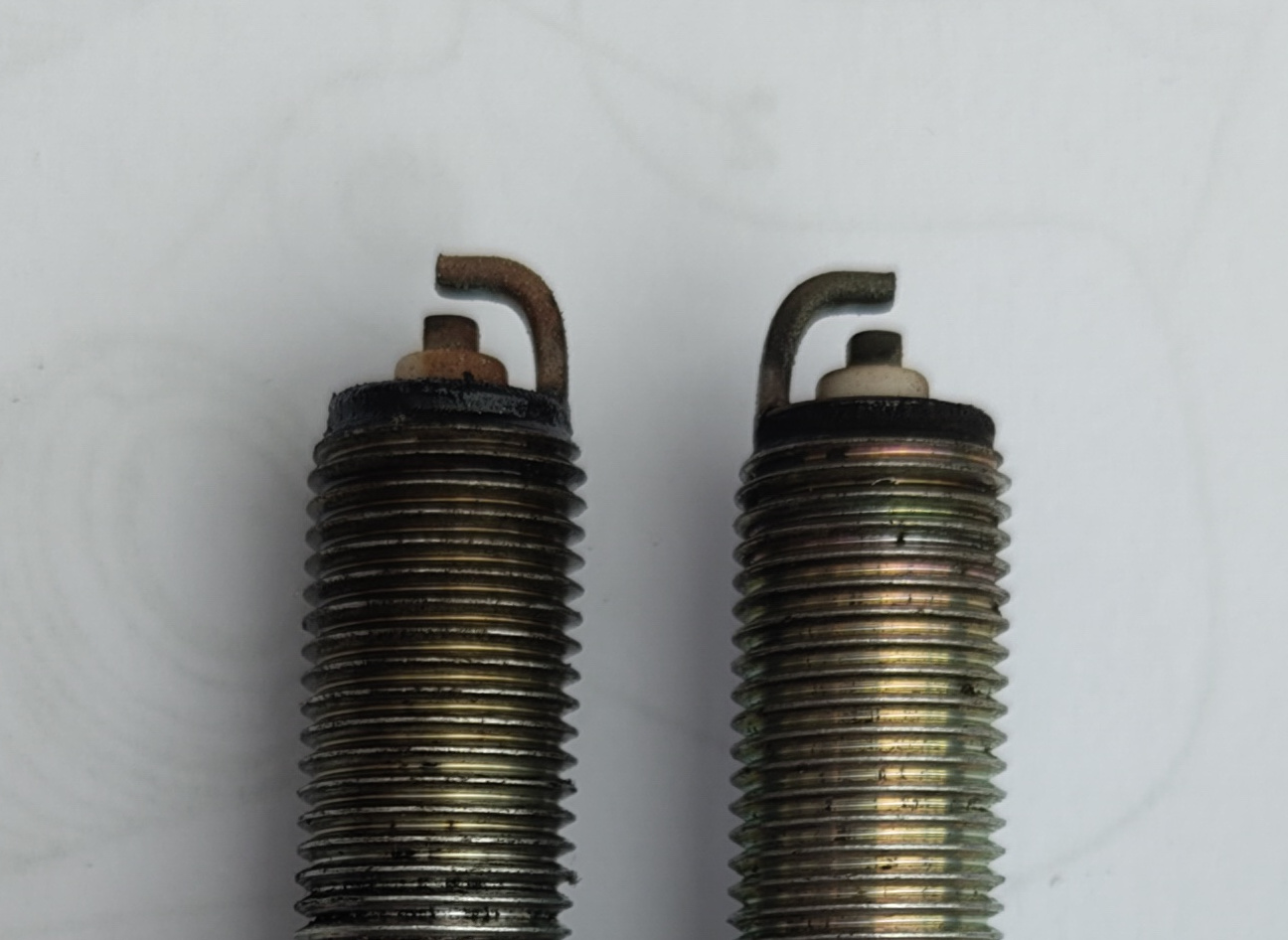
I had the old spark plugs unscrewed to the last turn of the thread to relieve compression pressure, which put them in the way of fitting the cam cover, so decided now was the time to fit the new spark plugs. Old ones looked fine, light tan on one side of the end, and clean on the other. (Bit of a bad photo.)

After cleaning the surface on the cylinder head I put the new rubber gasket in place then manoeuvred the cam cover into place whilst trying not to dislodge the gasket. This is made very difficult by the lack of space and requires simultaneously pushing pipes and wires out the way. With things roughly in place there followed about ten minutes poking with screwdriver and wriggling cover to get the gasket sitting properly in it’s groove. Once I was satisfied I fixed things down with the bolts and new seals. Phew, engine now all buttoned up.

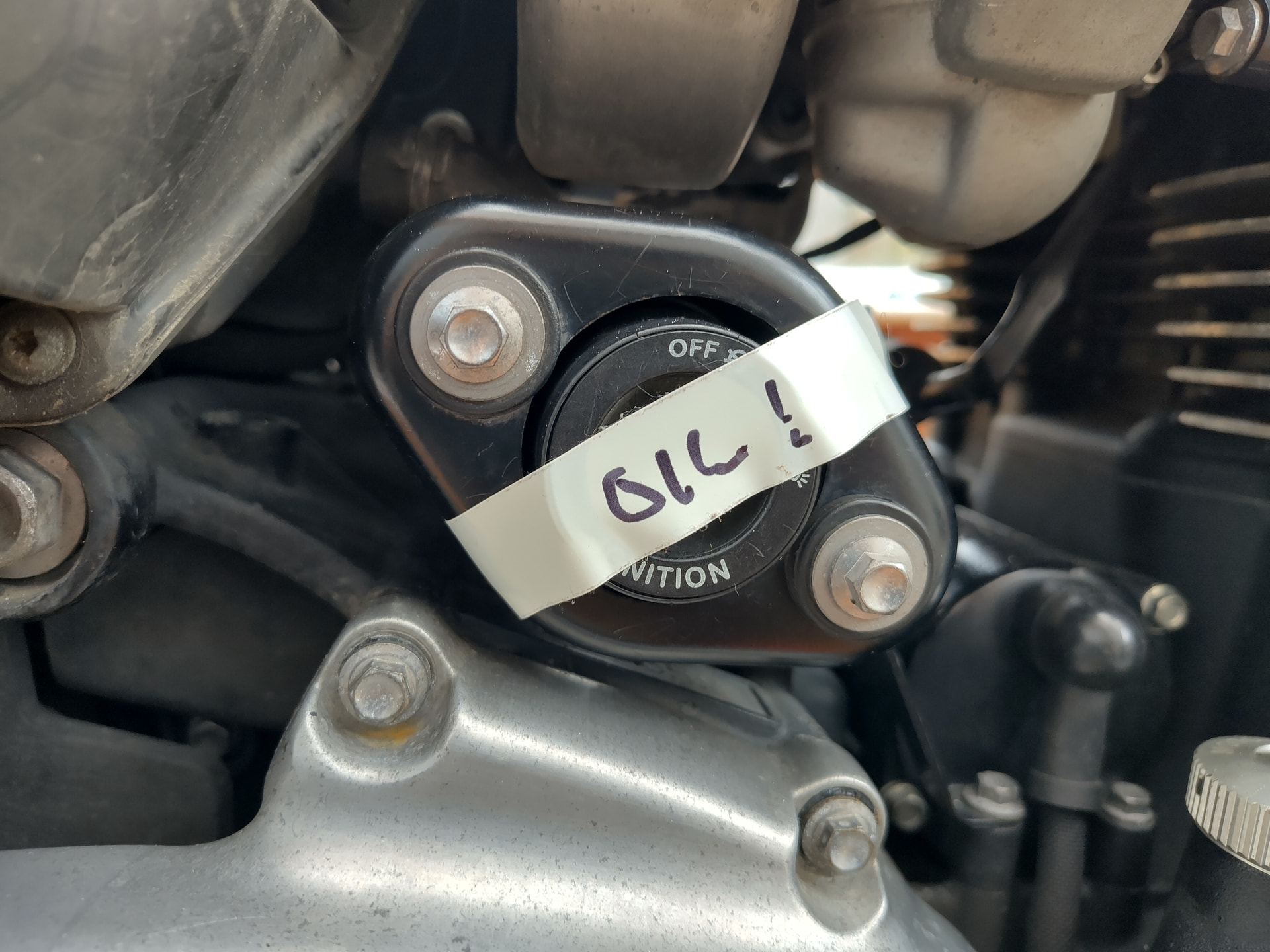
To finish things off I refitted the ignition coils and spark plug caps, put new air filters in the airbox and filled engine with oil. I hadn’t forgotten the latter, but to avoid catastrophe I had left a reminder over the ignition switch :slight_smile:

To fire up the engine I need the fuel tank back on but before that I want to have a look at the wiring loom because I’ve had problems with a front indication intermittently not working. That’s for tomorrow though…

7 Likes

4 Likes

Day Five

Started off with a look at the wiring for the front indicators and remembered that the problems I had last time was with the bullet connectors where they join the loom behind the steering headstock. I disconnected them and reconnected them but all seemed fine and decided not to worry about it now, they are still accessible with the tank connected so I set about doing that.

I put a couple of litres of fuel in the tank and left it five minutes to make sure there was no leaks. When all was good I put it back on the bike. For the fuel hose the Triumph service manual says to “reconnect the fuel hose by gently pushing downwards until the hose engages with a click”. There’s no ‘gentle’ about it though. It requires a lot of force to get it moving then stops half way, requiring even more force, presumably to get over the lip the latch engages with, until finally getting a satisfying click. I don’t remember the old hose being so clicky so was probably wise replacing it.

After reconnecting the electrical connectors and hooking them back onto their tabs, the only thing left was to bolt the tank on and fire her up!

It’s always scary for the first couple of seconds with the loud rattling of the cam-chain until the oil pressure engages the tensioner. But then it settled down into normal running noises and I was relieved. Time to connect the OBD2 interface and fire up TuneECU.

First thing whilst I remembered was to reset the service interval and the ECU ‘adaptations’, then looked at the MAP values for the two cylinders. I was hoping that they’d still be balanced like last time but unfortunately there was a large difference, the left cylinder was 7% higher than the right. Bugger. that means I’ve now got all the hassle of getting access to balance the carbs, but it’s a little worrying they are so far off. This could be down to change in valve clearances when I removed the rocker for the left intake valves and ended up with smaller clearance, and hence more valve lift. Though I’m not sure it would be as significant as 7% pressure difference.

But I getting ahead of myself, better finish checking work so far, like are there any petrol or oil leaks? Hmm, there’s a drip of oil at the bottom point of the alternator cover, that’s likely from dribbles when I had the cover off. If I’d thought about it I would have cleaned engine up before starting it. Anyway, let’s clean it now so I can check again when it’s run.

Speaking of oil, now the engine has had it’s first run I’d better top that up. I’ve now got half a litre left from a 4 litre bottle which is about right as the owners handbook says 3.4 litres for an oil and filter change.

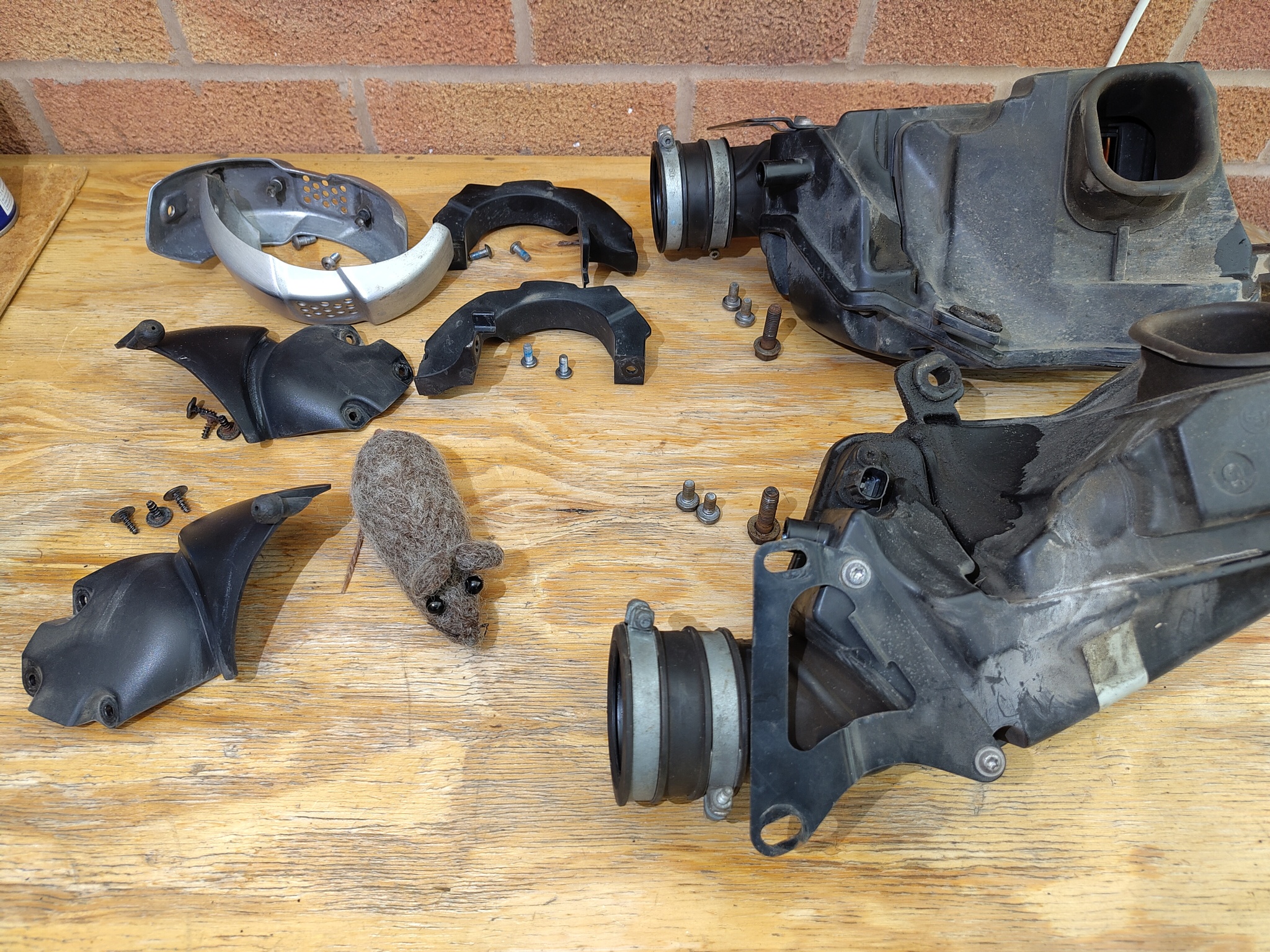
I’ve been waffling even more than normal and without even any pictures, better remedy that. Here’s a picture of your hero with all the bits removed to get access to the throttle bodies.

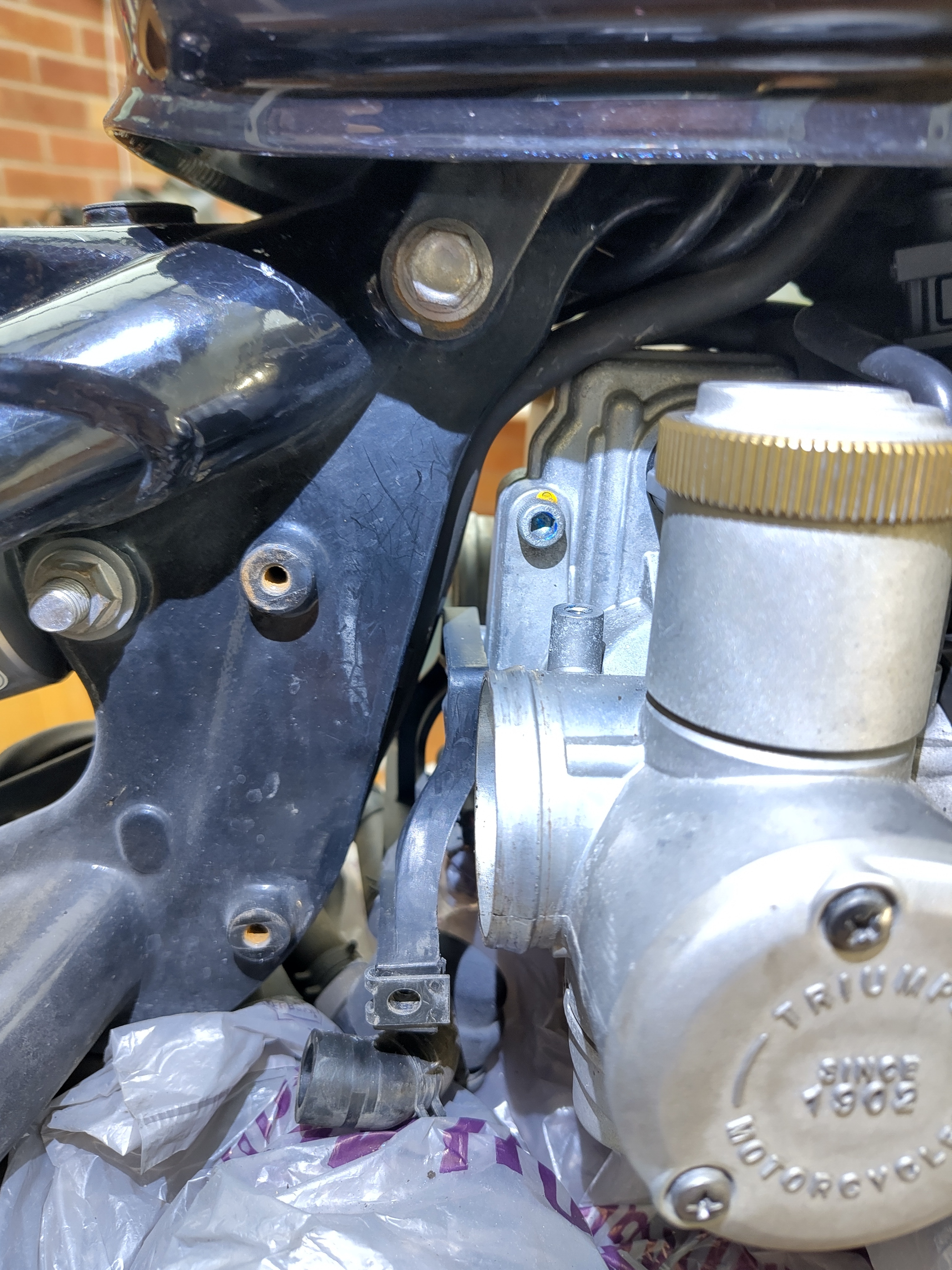
There’s not much space between engine and frame!

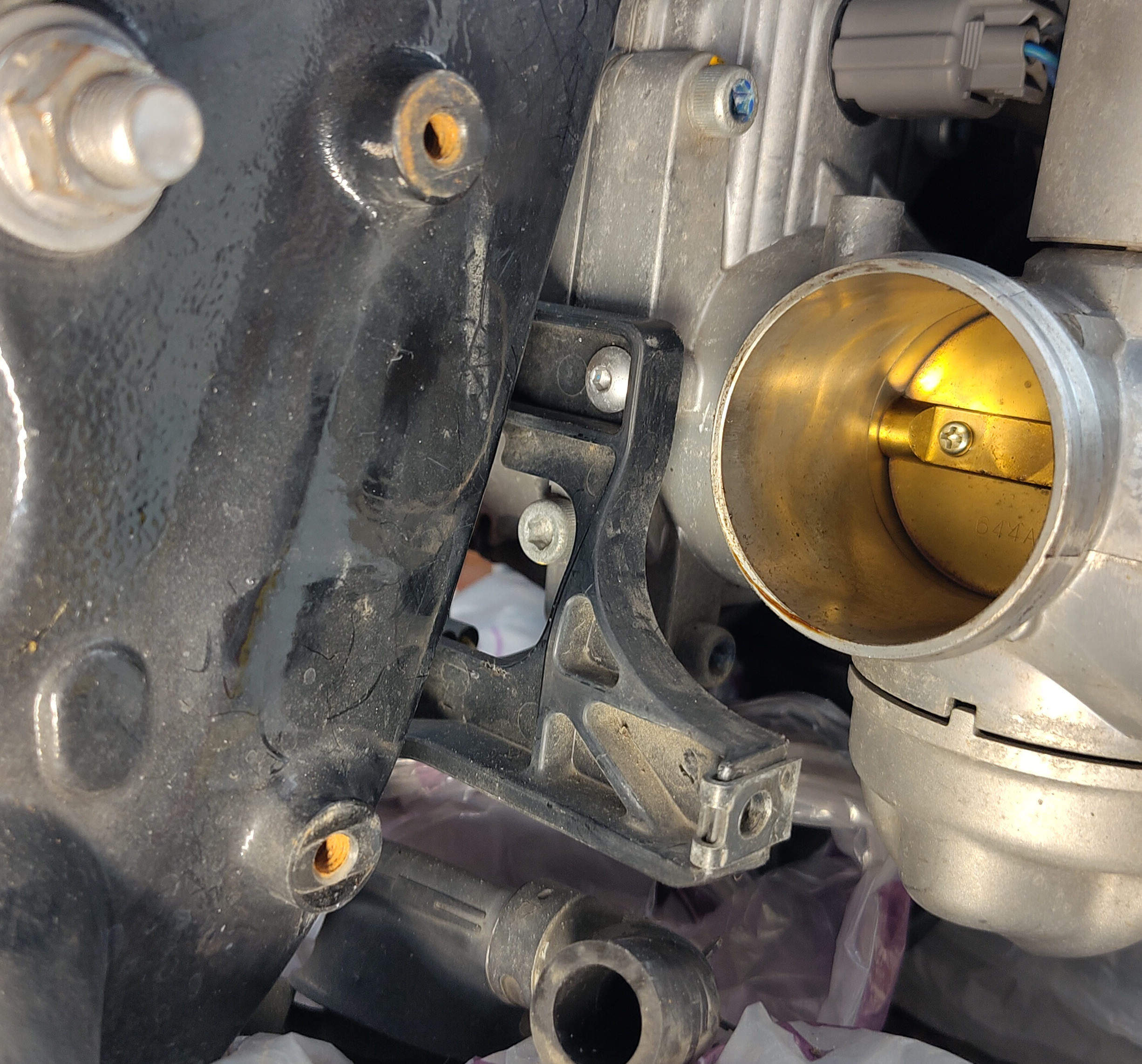
The blanking screw for the throttle adjuster is in the middle of this pic.

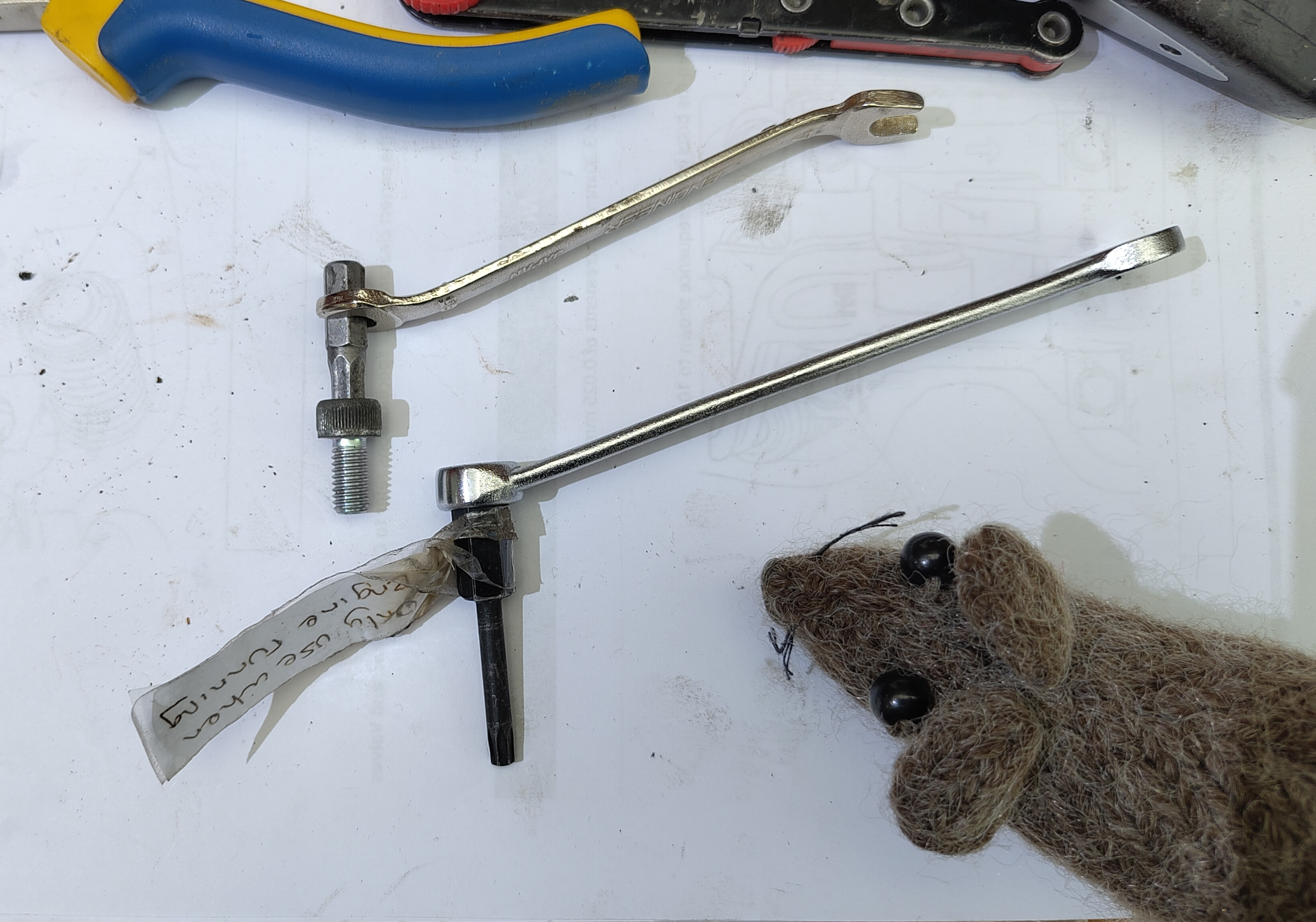
With near impossible access I need to use a 4mm hex bit manoeuvred into place with the fingertips of both hands, then turned with a 1/4 inch spanner. Similar story with the Triumph tool to turn the adjuster.

I’m rather concerned that it took a half turn of adjuster to get cylinders balanced at idle. Of course, this relies on the engine’s built in pressure sensors, so there’s always the possibility it’s the sensor accuracy is going off. Or one cylinder loosing a bit off suction due to wear/damage. I could probably come up with a load of reasons, but engine seemed to be running fine before this service so I will just see how things go.

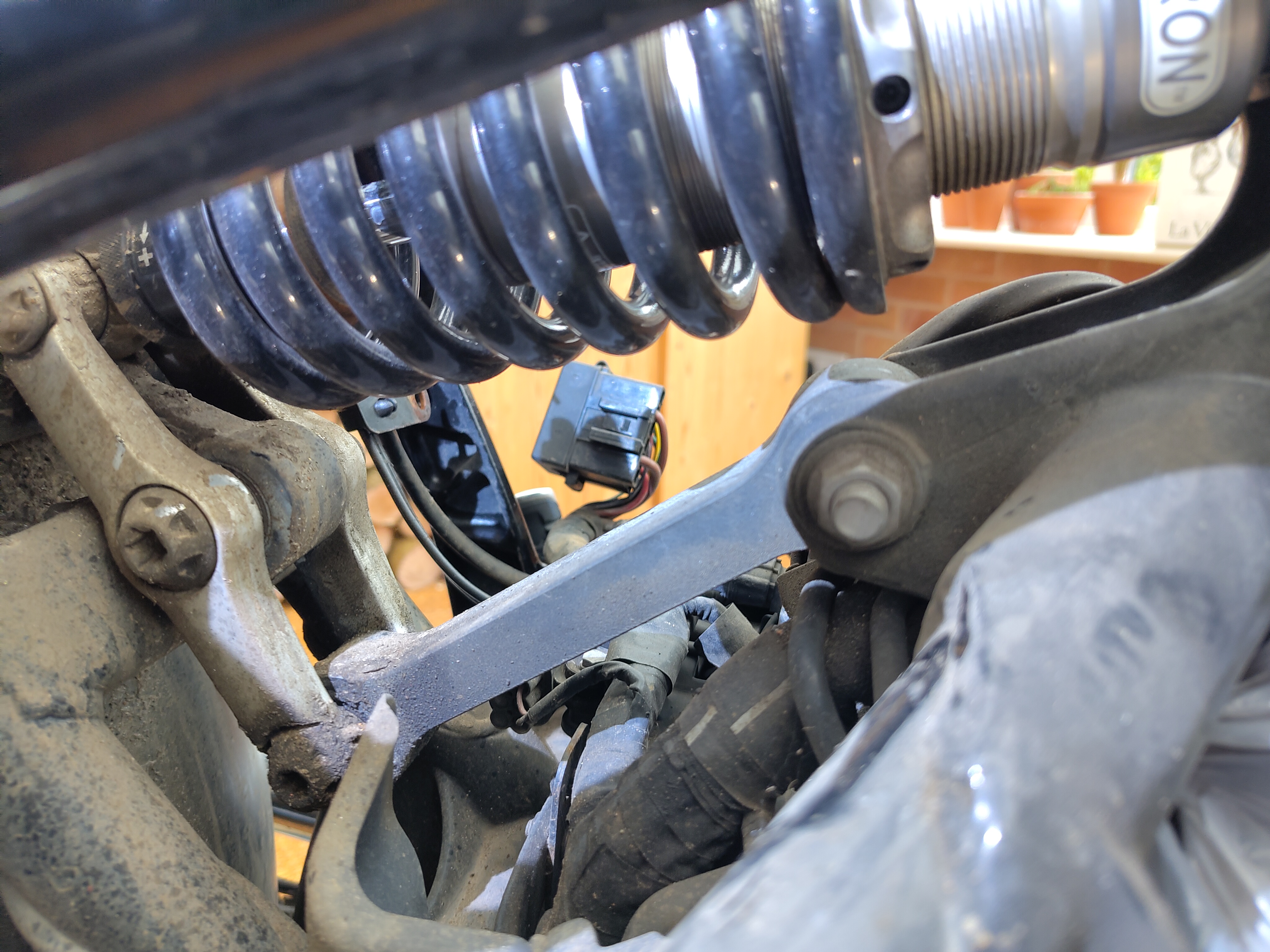
Now I have airboxes off I have access to rear suspension linkage, which at the very least needs a good clean and probably have the bolts out to grease. Think that last happened 2 years ago when I had swingarm out to get at faulty ECU.

But then if I’m doing that, how about replacing all the bearings too? They are original and I have been thinking it would be a good idea. And if the swingarm is comping out for that, what about the swingarm bearings. All a bit daunting after a week of engine servicing. Think the minimum is to at least get the linkage bolts out and cleaned and grease and check everything for free-play, including swingarm.

But that’s for tomorrow. Today it’s time for cake and beer. :face_savoring_food:

6 Likes

I don’t have a Soeedmaster and I’m unlikely to ever service one, but these long, detailed posts are most enjoyable. Keep ‘em coming! :slightly_smiling_face:

5 Likes